
What is Download Speed?
Updated: 2 days ago

Download speed is the rate at which data travels from the internet to your broadband connection and ultimately to your device. It affects how quickly websites load, files arrive, apps and games download, cloud content opens and video streams can be delivered. In the UK it is normally expressed in megabits per second (Mbps) or, on faster services, gigabits per second (Gbps).
The important point is that download speed is not simply another word for bandwidth. Bandwidth describes available capacity. Download throughput describes how much data is actually being transferred downstream over a period of time. A broadband package can therefore have a high headline download speed while an individual device sees less because of WiFi, Ethernet, router, server or wider network limitations.
What does download speed actually measure?
A download speed measurement describes a rate of data transfer towards you. A result of 100 Mbps means roughly 100 million bits are being transferred each second at that point in the test. It does not mean 100 megabytes per second.
8 bits make 1 byte.
100 Mbps corresponds to a theoretical 12.5 megabytes per second before overhead.
500 Mbps corresponds to a theoretical 62.5 megabytes per second.
1 Gbps, or 1,000 Mbps, corresponds to a theoretical 125 megabytes per second.
2.5 Gbps corresponds to a theoretical 312.5 megabytes per second.
Application transfer rates are normally lower than those simple conversions because protocols add overhead and performance can also be constrained elsewhere in the path.
Download speed, bandwidth and throughput are different
These terms are related, but they should not be treated as interchangeable. Bandwidth is the capacity available to carry traffic. Download speed is the downstream rate being discussed or measured. Throughput is the useful rate actually achieved across the path.
If a broadband service is sold as 500 Mbps but a laptop achieves 180 Mbps over WiFi, it does not automatically follow that the broadband line itself is delivering only 180 Mbps. The wireless link may be the narrowest part of the path.
Download speed vs upload speed
Download speed covers data travelling towards your connection. Upload speed covers data travelling away from it. Most web browsing, streaming and conventional file downloads are downstream-heavy, while cloud backups, video uploads, live streaming and remote access can be much more dependent on upstream capacity.
Many UK broadband products are asymmetric, meaning the advertised download rate is substantially higher than the upload rate. Full fibre describes the fibre access technology, not a promise that download and upload speeds will be identical.
What uses download speed?
Loading websites, images and web applications.
Streaming television, films and online video.
Downloading games, applications and operating system updates.
Receiving files from cloud storage or remote servers.
Game installation and large game patches.
Software repositories and development environments.
Downloading media from a NAS or remote network over the internet.
Multiple devices performing these activities at the same time.
Interactive activities such as gaming can work well without consuming hundreds of megabits per second continuously. Their experience may depend more heavily on latency, jitter, packet loss and congestion than raw download capacity.
What download speed looks like in the UK
Ofcom's Connected Nations 2025 report found that the UK average maximum download speed on active residential connections increased from 223 Mbit/s in 2024 to 285 Mbit/s in 2025, an increase of about 27.8%. Ofcom describes this as the average of the maximum download speeds delivered to residential premises, such as the router, as reported by providers. It should not be interpreted as the speed every device or household receives.
England: 288 Mbit/s average maximum download speed in 2025.
Northern Ireland: 325 Mbit/s.
Scotland: 273 Mbit/s.
Wales: 243 Mbit/s.
UK: 285 Mbit/s.
Northern Ireland's figure was about 33.7% higher than Wales's. Ofcom says its higher average is likely to reflect greater full-fibre availability and take-up.
The access landscape is also changing quickly. Ofcom's Spring 2026 update reports full fibre availability at 82% of UK homes and gigabit-capable broadband at 89%. Openreach currently offers full-fibre wholesale tiers with headline downloads up to 1.8 Gbps and announced plans in August 2026 to expand XGS-PON, including planned speeds up to 8.5 Gbps. CityFibre says its nationwide XGS-PON upgrade is complete and supports multi-gigabit symmetrical wholesale services.
Techie Broadband analysis: headline capacity is growing faster than average consumption
Ofcom recorded average fixed broadband data use of 583 GB during July 2025, up from 531 GB in July 2024. That is an increase of about 9.8%, while the UK average maximum download speed increased by about 27.8% over the same reporting periods.
Spread evenly over a 31-day month, 583 GB corresponds to an average continuous data rate of only about 1.74 Mbps. That does not mean a 2 Mbps connection would be adequate. Household traffic is bursty. A game update might demand hundreds of megabits per second for a short period and then the connection can be almost idle.
This distinction matters because a faster download tier primarily provides more capacity when demand occurs. It can shorten large transfers and create headroom for several users without implying that a household continuously consumes anything close to its headline line rate.
How quickly can different download speeds transfer a 10 GB file?
A 10 GB file contains about 80 gigabits using decimal networking units. Dividing that by the line rate gives a useful theoretical comparison before protocol overhead and server or device limitations.
50 Mbps: about 26 minutes 40 seconds.
100 Mbps: about 13 minutes 20 seconds.
285 Mbps: about 4 minutes 41 seconds.
500 Mbps: about 2 minutes 40 seconds.
1 Gbps: about 1 minute 20 seconds.
2.5 Gbps: about 32 seconds.
These are mathematical line-rate illustrations, not promises. A game platform, content delivery network, storage device, WiFi connection or computer may prevent the transfer from sustaining the full broadband rate.
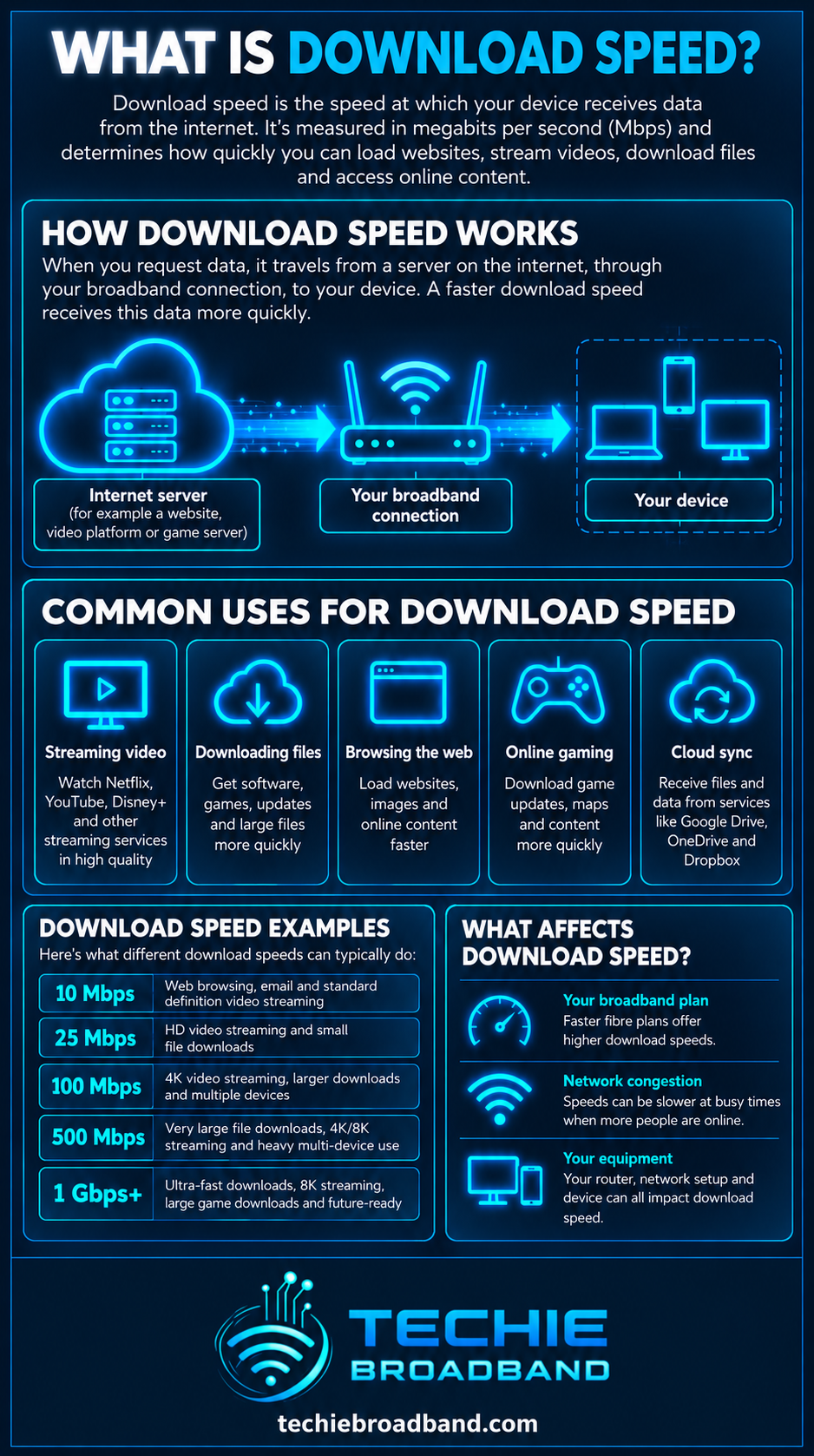
Download speed data infographic
The infographic below brings the practical comparisons together. It shows why the benefit of higher download speed becomes clearest with simultaneous household demand and large transfers, rather than assuming every everyday activity becomes proportionally faster.
Worked example: what happens in a busy household?
Imagine a household with a 4K stream using around 25 Mbps, another television stream using 10 Mbps, a game download trying to use 70 Mbps, web and social activity using 5 Mbps and background cloud traffic using another 10 Mbps. That creates around 120 Mbps of downstream demand in this simplified example.
On a 100 Mbps connection, demand exceeds the headline capacity by about 20 Mbps.
On a 150 Mbps connection, around 30 Mbps of headline capacity remains.
On a 300 Mbps connection, around 180 Mbps remains.
On a 500 Mbps connection, around 380 Mbps remains.
On a 1 Gbps connection, around 880 Mbps remains.
Applications do not always demand their maximum rate continuously, so real traffic is more complicated. The example demonstrates the concept of headroom: a faster service can allow a large download to continue quickly without competing as aggressively with other household traffic.
How much download speed do you actually need?
There is no universal number because the right tier depends on simultaneous use, not simply how many devices are connected. Twenty idle smart-home devices may use very little bandwidth, while one computer downloading a 100 GB game can consume most of a slower connection.
Light browsing, email and occasional HD streaming can work comfortably on relatively modest connections when only a few people are active.
Busy households with several simultaneous streams and downloads benefit from additional headroom.
Large game libraries, workstation images, creative assets and frequent software downloads make faster tiers materially more useful.
Multi-gigabit services provide enormous transfer capacity, but devices and local networking must also support multi-gigabit rates if you want to exploit them fully.
Why a 1 Gbps broadband package may not download at 1 Gbps
The end-to-end path matters. Your broadband access speed is only one link in a chain that can include the remote server, the internet route, ISP network, access network, ONT or modem, router WAN interface, router processing, Ethernet switch, WiFi radio, network adapter, storage and the application itself.
A Gigabit Ethernet link cannot deliver a multi-gigabit service to one device at multi-gigabit speed.
WiFi throughput can be substantially lower than the theoretical PHY rate shown by the device.
A remote server may deliberately cap each download.
A slow SSD or hard drive can become relevant at very high transfer rates.
Security software or router processing can limit throughput.
Congestion elsewhere on the route can reduce a particular transfer without changing the access line's headline capability.
WiFi speed is not the same as broadband download speed
A speed test performed over WiFi measures the combined result of the broadband connection and the wireless path to the test device. Distance, walls, interference, channel width, WiFi generation, access-point placement and client capability can all change the result.
When diagnosing an unexpectedly low download result, test a capable device over wired Ethernet first where practical. If the wired result is strong and the WiFi result is weak, buying a faster broadband package is unlikely to fix the underlying wireless problem.
Ethernet can become the bottleneck on faster broadband
Faster FTTP products increasingly expose local network limits that were irrelevant on slower connections. A router with a 2.5 GbE WAN port but only 1 GbE LAN ports may accept a multi-gigabit service while no single wired device can receive the full rate through a 1 GbE port.
100 Mbps Ethernet: unsuitable for broadband tiers above 100 Mbps.
1 GbE: appropriate for gigabit-class networking but cannot carry a 2.5 Gbps service to one client at full rate.
2.5 GbE: useful for 2 Gbps and 2.5 Gbps broadband tiers.
5 GbE and 10 GbE: increasingly relevant for faster multi-gigabit access and high-speed local networks.
Actual usable Ethernet throughput is lower than the nominal interface rate because of protocol overhead.
Does faster download speed reduce latency?
Not automatically. Latency measures delay rather than transfer capacity. A 1 Gbps connection can have higher latency than a 100 Mbps connection, and vice versa.
Extra capacity can still help indirectly when the existing line regularly saturates. If queues build during large transfers, latency can increase. This is closely related to bufferbloat.
Does download speed matter for gaming?
Download speed matters most for installing games, downloading large patches and retrieving game assets. Actual online gameplay normally uses far less bandwidth than a modern full-fibre connection can provide. For the game itself, latency, jitter and packet loss can be more important.
If a game feels unstable despite plenty of headline speed, investigate jitter and packet loss rather than assuming more Mbps is automatically the answer.
How to test your download speed properly
Connect a capable computer to the router using Ethernet where possible.
Confirm the Ethernet link has negotiated at the expected speed.
Pause large downloads, cloud synchronisation and other heavy traffic on the network.
Choose a reputable speed test and use a geographically sensible server.
Run several tests rather than relying on a single result.
Repeat against another test service or server.
Compare results at different times if you suspect congestion.
Then test over WiFi separately if you want to understand wireless performance.
A speed test is itself a network workload. Results can vary according to the test server, route, browser or application, device capability and current network load.
Why a browser download can be slower than a speed test
A speed test is designed to push the connection hard, often using multiple parallel flows and a nearby high-capacity server. A normal download may use a different server, different route, fewer connections or a service-imposed rate limit. The two results therefore answer different questions.
If several independent high-capacity tests repeatedly reach the expected line rate but one website downloads slowly, the broadband access connection may not be the limiting factor.
Download speed and application goodput
The number an application cares about is the useful payload it receives. Some of the bits crossing the connection belong to Ethernet, IP, TCP or other protocol overhead rather than the file itself. Retransmissions can also consume capacity without delivering new payload.
That is why a theoretical conversion such as 1 Gbps equals 125 MB/s should be treated as a ceiling before overhead, not a guaranteed file-copy rate.
Frequently asked questions about download speed
Is 100 Mbps a good download speed?
For many UK households, 100 Mbps provides substantial capacity for normal browsing, streaming and multiple simultaneous activities. Whether it is enough depends on concurrent demand, large download expectations and the number of heavy users rather than the device count alone.
Is 500 Mbps noticeably faster than 100 Mbps?
It can be dramatically faster for large transfers when the source and local network can supply the extra throughput. A theoretical 10 GB transfer falls from about 13 minutes 20 seconds at 100 Mbps to about 2 minutes 40 seconds at 500 Mbps. A normal web page will not necessarily feel five times faster because many other delays are involved.
Is 1 Gbps worth it?
It is most valuable for households with substantial simultaneous demand, frequent large downloads or users who value shorter transfer times. If your existing connection is rarely close to capacity and your problem is WiFi coverage or latency, upgrading to 1 Gbps may produce less benefit than expected.
Does full fibre guarantee gigabit download speeds?
No. FTTP describes the fibre access connection to the premises. The retail speed still depends on the package ordered and the underlying network's available products. Full-fibre packages can therefore range from modest speeds to multi-gigabit services.
Why do I get less download speed on my phone than my computer?
The devices may have different WiFi radios, antenna designs, supported standards, channel widths, signal conditions and processing capability. A wired computer may also bypass WiFi entirely, making it a better way to isolate the broadband line itself.
The key point
Download speed tells you how quickly data can be delivered towards you, but the headline number only makes sense in context. Capacity, actual throughput, WiFi, Ethernet, remote servers, device capability and latency all contribute to the experience.
The UK's access networks are moving rapidly into gigabit and multi-gigabit territory. That makes understanding the rest of the path more important, not less. Once broadband capacity stops being the narrowest link, the bottleneck simply moves somewhere else.
For the wider capacity concept, continue with What is Bandwidth?. For the opposite direction of traffic, read What is Upload Speed?. You can also use the Techie Broadband terminology guide when a networking term needs a quick definition.
Techie Broadband calculation note: transfer-time, percentage and capacity figures in this article are mathematical illustrations using decimal networking units unless stated otherwise. They exclude protocol overhead and should not be interpreted as guaranteed application performance.
