
What is Route Flapping?
Updated: 3 days ago

Route flapping is repeated instability in routing information, where a route to an IP prefix is advertised, withdrawn, re-advertised or repeatedly replaced by another path. In BGP, frequent changes generate routing updates that must be processed and propagated, potentially increasing routing churn and delaying stable convergence.
A route flap is not the same thing as packet loss, latency or a broadband line changing speed. It happens in the routing control plane. Users may notice an effect only when the instability changes reachability or forces traffic onto another path.
What does route flapping mean?
A route represents reachability to a destination prefix. If that reachability keeps changing, neighbouring routers receive repeated updates and recalculate which path they should use. The informal term for this behaviour is route flapping.
RFC 2439 describes route flap as excessive updates to the advertised reachability of internet prefixes and deliberately distinguishes it from simple periodic oscillation. RFC 2439: BGP Route Flap Damping documents the original BGP damping mechanism developed to limit the impact of excessive route changes.
A simple route flapping example
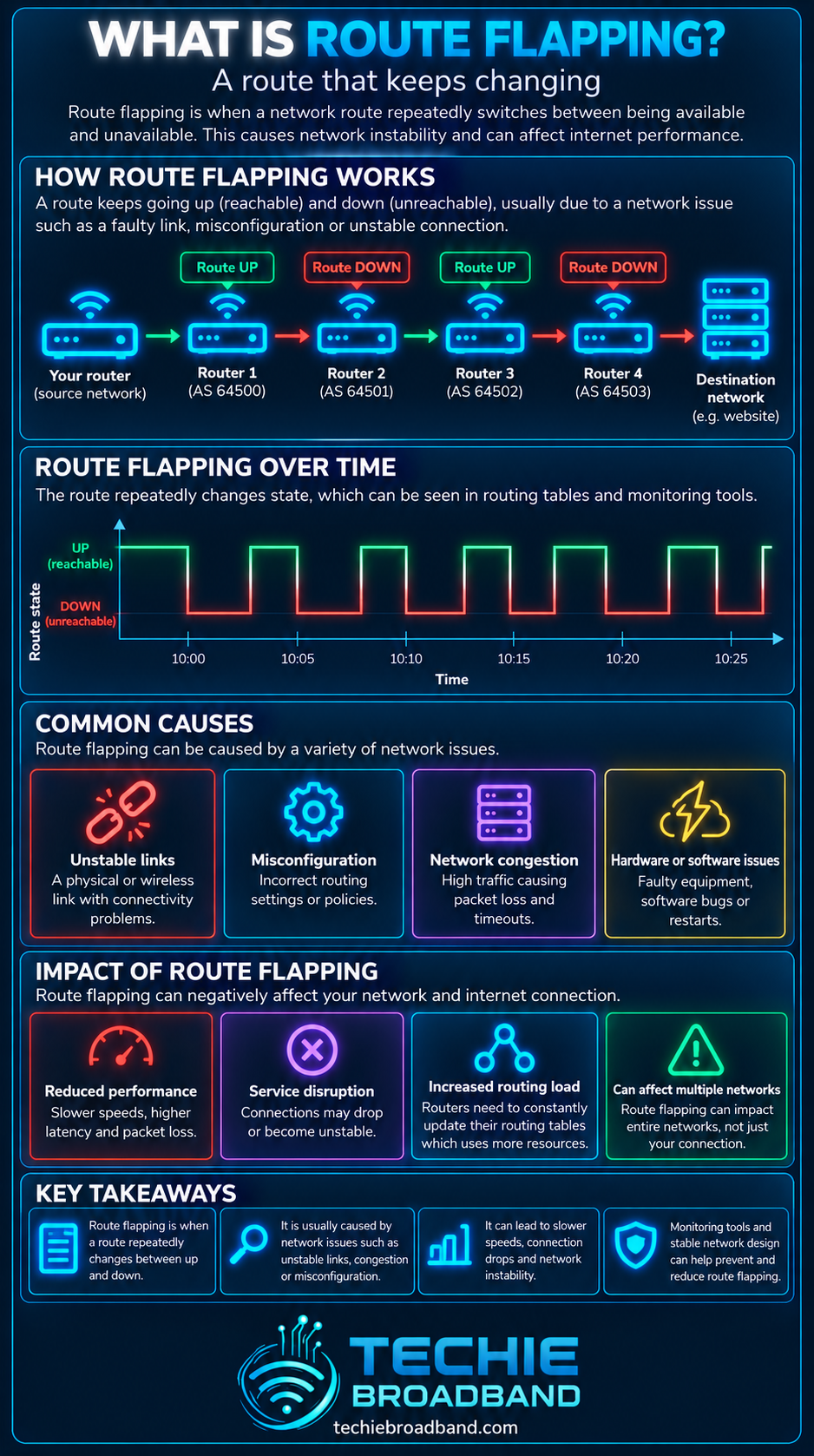
Imagine a prefix that is reachable through one external link. The link fails, returns, fails again and returns again. Each state change can cause BGP to withdraw or re-advertise reachability. Other BGP speakers then process those changes and may select different paths while the network reconverges.
The sequence can be simplified as: route available → route withdrawn → route available → path changed. A single legitimate routing change is not normally described as flapping. The defining feature is repeated instability.
The infographic below visualises that cycle, common causes and the principle behind route flap damping.
What causes route flapping?
Route flapping is a symptom of instability rather than one specific fault. The source can sit at the physical, protocol, configuration or upstream network layer.
An unstable physical circuit or interface repeatedly changes state.
A BGP peering session repeatedly resets and re-establishes.
A router or routing process repeatedly restarts.
Configuration or routing policy changes repeatedly alter advertisements.
An upstream network repeatedly announces and withdraws reachability.
A failing device, power problem or software fault creates intermittent connectivity.
Changes inside an IGP can repeatedly alter the path feeding information into BGP.
Automation or traffic engineering changes can unintentionally produce repeated path changes.
Route flapping and BGP
BGP exchanges reachability between autonomous systems. When a route changes, a BGP speaker can send an UPDATE to its peers. Those peers run their own decision process and may propagate a new best path onwards. This is why instability originating in one place can create work elsewhere in the routing system.
The effect is often called BGP churn. Churn describes the volume of routing changes being processed rather than the amount of user traffic flowing through the network. A quiet data link can still be associated with significant control plane activity if routing information is unstable.
Route flapping is not the same as a BGP session flap
A BGP session flap is specifically a BGP neighbour relationship repeatedly going down and coming back up. Route flapping is broader. A prefix can flap because the underlying session resets, but route advertisements can also change while a BGP session itself remains established.
This distinction matters during diagnosis. Seeing repeated route withdrawals does not prove the BGP session is failing. The operator needs to inspect neighbour state, update history, interface state and the origin of the changing prefix.
What is BGP convergence?
Convergence is the process by which routers react to routing changes and settle on a consistent usable set of paths. During a flap, that process can be triggered repeatedly before the network has remained stable for long.
Convergence time is not one universal number. It depends on topology, protocol timers, route propagation, path alternatives, implementation behaviour and the nature of the failure. A network with a valid alternative path may continue forwarding traffic while routing changes are processed. A prefix with no usable alternative can become temporarily unreachable.
How route flapping can affect broadband users
Most home broadband users never see BGP updates directly. They experience the consequences only if instability affects a route used by their traffic. Possible symptoms include intermittent reachability to one service, changing latency, short connection failures or traffic moving onto a different path.
A route change can alter latency without changing the speed of the FTTP access line. It can also change the visible traceroute because traffic is now crossing different routers or networks.
If only one destination or group of destinations is affected while the broadband connection itself remains stable, wider routing or interconnection behaviour becomes more plausible than a fault with the local fibre link.
Route flapping is not packet loss
Packet loss means packets fail to reach their destination. Route flapping means routing information is repeatedly changing. A flap can contribute to packet loss during convergence or temporary loss of reachability, but the two measurements describe different things.
Equally, packet loss can occur with completely stable routing because of congestion, faulty hardware, radio interference, overloaded equipment or other causes. Do not infer route flapping simply because a ping test loses packets.
Route flapping is not network congestion
Network congestion occurs when demand approaches or exceeds the capacity available at part of the path. Route flapping is control plane instability. Congestion can contribute indirectly if severe conditions destabilise sessions or equipment, but a congested path does not automatically flap.
What is route flap damping?
Route Flap Damping, usually shortened to RFD, is a BGP mechanism designed to reduce the propagation of persistently unstable routing information. Repeated changes accumulate a penalty. If the penalty crosses a configured suppression threshold, the route can be temporarily suppressed. The penalty decays over time and the route can later become eligible for reuse.
The original mechanism is specified in RFC 2439. The important modern caveat is that damping is not simply a switch that should always be enabled. Poor parameters can suppress otherwise useful reachability for too long.
Why route flap damping became controversial
The original goal was sensible: protect routing systems from excessive update processing. Operational experience later showed that aggressive damping could make convergence and reachability worse by suppressing routes after relatively modest instability.
RIPE's 2006 guidance recommended disabling the then common forms of RFD because the side effects could be worse than leaving damping off. Later work revisited the parameters. RIPE 580 and RFC 7196 describe approaches intended to make damping usable for the small set of prefixes that flap excessively.
The practical lesson is not that RFD is universally good or universally bad. The parameters, implementation and operational objective matter. Modern network operators should follow current vendor and routing community guidance rather than blindly applying historic defaults.
Techie Broadband analysis: why a small unstable set can create disproportionate churn
RIPE 580 reports experimental findings in which 3% of observed prefixes generated 36% of BGP updates, while 0.01% generated 10% of updates. Those figures are historical experimental findings, not a claim about the current 2026 global routing table.
Techie Broadband calculation: using those published figures, the 3% group generated updates at an average rate 12 times its share of prefixes because 36 ÷ 3 = 12. The 0.01% group generated updates at 1,000 times its share because 10 ÷ 0.01 = 1,000. This demonstrates why operators became interested in targeting the most unstable prefixes rather than penalising every ordinary route change.
Source: RIPE 580, published January 2013. The calculation above is Techie Broadband analysis of the percentages reported in that document.
How route flapping interacts with peering and transit
Internet routes cross organisational boundaries through peering and IP transit. A prefix that becomes unstable can cause different networks to select alternatives according to their own BGP policy. The result may be a path change rather than complete loss of connectivity.
Because internet routing can also be asymmetric, the route towards a destination and the route used by return traffic do not have to change in the same way or at the same time.
What route flapping looks like on UK broadband
A UK broadband connection can be locally healthy while a route farther across the internet is unstable. The home router, ONT and access circuit may remain connected throughout. The changing route could be inside the ISP, at an interconnection, in an upstream transit network or within the destination network.
The access technology does not determine whether BGP routes elsewhere will flap. Openreach FTTP, CityFibre, an altnet, cable or another access network gets the customer into a provider network. Internet routing beyond that point depends on the ISP, destination, interconnection and routing policy.
How to diagnose suspected route flapping
Define the symptom. Record which destinations fail, when the problem starts and whether the broadband connection itself remains up.
Test a known stable destination as a control. If everything fails together, investigate the local connection and ISP access path before assuming BGP instability.
Use wired Ethernet where practical to remove WiFi variability from the test.
Run repeated ping tests to the affected destination and record timestamps, but remember that packet loss alone does not prove a route flap.
Run traceroute repeatedly and look for meaningful path changes that correlate with the user-visible problem.
Compare IPv4 and IPv6 separately if both are available because their routes can differ.
Test from another connection or external monitoring point. This helps distinguish a destination-specific routing problem from the local access network.
If you operate the network, inspect BGP neighbour state, update history, interface logs and route advertisements for the affected prefix.
Correlate routing changes with physical link events, maintenance, configuration changes or upstream incidents.
Escalate with timestamps, affected prefixes or destinations, traceroutes and evidence of repeated route changes rather than a vague report that the internet is unstable.
Common route flapping misconceptions
Every BGP update is a route flap. False. Normal routing changes happen; flapping describes repeated instability.
Route flapping means the broadband line is dropping. Not necessarily. The access connection can remain stable while a route elsewhere changes.
Route flapping and packet loss are the same. They are different phenomena, although a flap can sometimes cause temporary loss.
More traceroute changes always prove flapping. Load balancing and normal routing policy can also change the visible path.
Route flap damping always improves stability. Incorrect. Poor damping parameters can delay reachability and convergence.
A different route is automatically a worse route. Networks can legitimately converge onto a healthy alternative path.
Route Flapping FAQs
What is a route flap in BGP?
A BGP route flap is repeated change in the advertised reachability or path for a prefix, such as repeated withdrawals, re-advertisements or path changes.
Can route flapping cause packet loss?
Yes, it can during periods when a usable path is temporarily unavailable or traffic is reconverging. Packet loss can also have many causes unrelated to routing, so loss alone does not prove flapping.
What causes a BGP route to flap?
Common causes include unstable links, BGP session resets, router restarts, changing routing policy, upstream instability and repeated changes in the underlying network.
What is route flap damping?
Route flap damping is a BGP mechanism that assigns penalties to unstable routing information and can temporarily suppress a route after sufficient repeated instability. The penalty decays over time.
Should route flap damping always be enabled?
No. Historic aggressive settings could cause harmful over-suppression. Operators should use current implementation and routing community guidance and understand the parameters before deploying RFD.
Can a home broadband user fix route flapping?
Usually not when the instability is in an ISP, upstream or destination network. The useful role for the user is to collect repeatable evidence, eliminate local WiFi and equipment issues, and provide timestamps and path information to the relevant operator.
Key takeaway
Route flapping is repeated instability in routing information, not simply a slow connection or a lost packet. In BGP, repeated advertisements, withdrawals and path changes create routing churn and can repeatedly trigger convergence. The effect on users depends on whether a usable alternative path exists and how quickly the network stabilises. Route flap damping was created to control excessive instability, but modern practice requires careful parameters because aggressive damping can itself delay reachability.
To explore the related technical concepts used in this Route Flapping guide, visit our broadband terminology guide.
