
What is Symmetrical Speeds?
Updated: 1 day ago

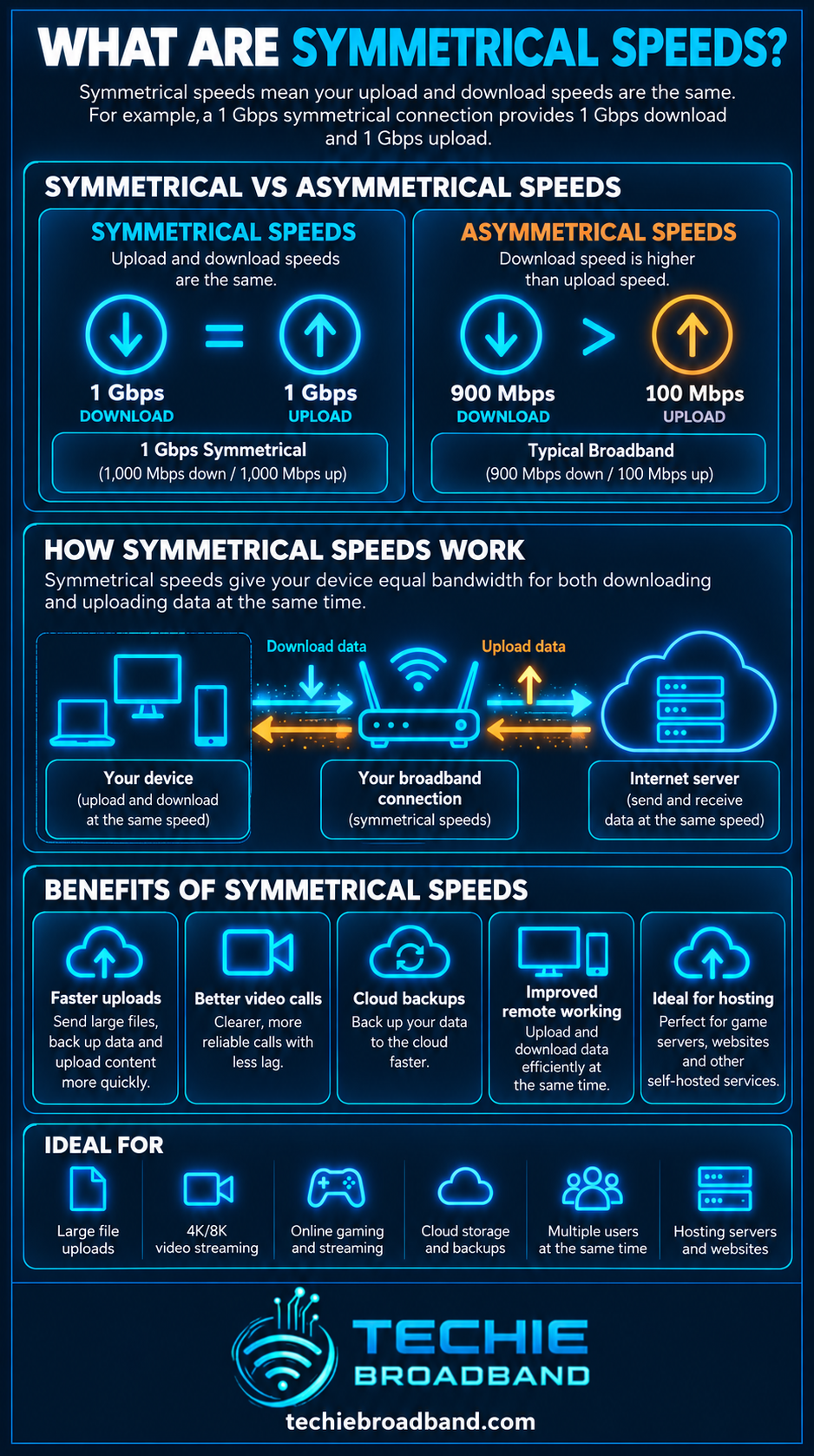
Symmetrical speeds mean a broadband connection is sold with the same upload and download speed. A 1 Gbps symmetrical service, for example, offers up to 1 Gbps downstream and up to 1 Gbps upstream. The important word is equal: symmetrical describes the balance between the two directions, not whether the connection is dedicated, uncontended, guaranteed or capable of delivering the headline rate every second.
That distinction matters because UK broadband has traditionally been heavily weighted towards downloads. Full fibre and newer access technologies are changing that, but a fibre connection is not automatically symmetrical and even a physically symmetric network technology can be sold using asymmetric product profiles.
What does symmetrical broadband actually mean?
Every internet connection moves traffic in two directions. Download traffic travels towards you. Upload traffic travels away from you. A symmetrical broadband product gives both directions the same advertised service rate.
500 Mbps download + 500 Mbps upload = symmetrical.
1 Gbps download + 1 Gbps upload = symmetrical.
900 Mbps download + 100 Mbps upload = asymmetric.
2.5 Gbps download + 2.5 Gbps upload = symmetrical.
Symmetry is therefore a ratio, not a statement about absolute speed. A 100 Mbps symmetrical connection is still symmetrical even though a 1 Gbps asymmetric connection may have a much higher download rate.
Symmetrical speeds vs download speed and upload speed
Download speed measures how quickly data can travel from the internet to your connection. Upload speed measures the reverse direction. If you want the deeper mechanics behind each, read What is Download Speed? and What is Upload Speed?.
Bandwidth is the capacity available to carry that traffic. It is related to speed but it is not the same concept. The What is Bandwidth? guide explains why a headline Mbps figure does not describe the whole connection.
Why were broadband connections traditionally asymmetric?
Most residential broadband products were designed around an assumption that households consumed far more data than they transmitted. Web browsing, television, software downloads and streaming video created strong downstream demand, while upstream traffic was comparatively light.
Access technologies and product design reflected that pattern. The result was often a large downstream allocation and a much smaller upstream allocation. That is still visible in many UK broadband products today.
The usage pattern has changed. Cloud backup, remote working, video calls, live streaming, large media uploads, home servers, CCTV, off-site replication and creator workflows can all place sustained demand on the upstream path.
Why symmetrical speeds matter in real use
Symmetrical broadband does not make every application faster. It removes a directional bottleneck when your workload needs significant upstream capacity.
Cloud backup can complete dramatically faster.
Large project files can leave your network as quickly as similarly sized downloads arrive.
Creators can upload high bitrate video without waiting on a small upstream profile.
Remote workers have more headroom for video, VPN traffic and file synchronisation.
Self-hosted services can serve remote users with much more outbound capacity.
Off-site NAS replication can run at useful speeds without monopolising a narrow upload path.
Multiple simultaneous upstream workloads are less likely to saturate the connection.
Techie Broadband calculation: uploading 100 GB
Using decimal networking units, 100 GB is approximately 800 gigabits before protocol overhead. The theoretical minimum transfer time is therefore 800 gigabits divided by the available upload rate.
100 Mbps upload: 8,000 seconds, or 2 hours 13 minutes 20 seconds.
500 Mbps upload: 1,600 seconds, or 26 minutes 40 seconds.
1 Gbps upload: 800 seconds, or 13 minutes 20 seconds.
2.5 Gbps upload: 320 seconds, or 5 minutes 20 seconds.
5.5 Gbps upload: about 2 minutes 25 seconds.
8.5 Gbps upload: about 1 minute 34 seconds.
These are theoretical line-rate calculations. TCP or QUIC overhead, encryption, server limits, storage performance, routing, congestion and application behaviour mean real transfers normally take longer.
The comparison shows why symmetry becomes meaningful when the task itself is upstream heavy. Moving from 100 Mbps to 1 Gbps upload cuts the theoretical 100 GB transfer time by a factor of ten.
Symmetrical does not mean dedicated or uncontended
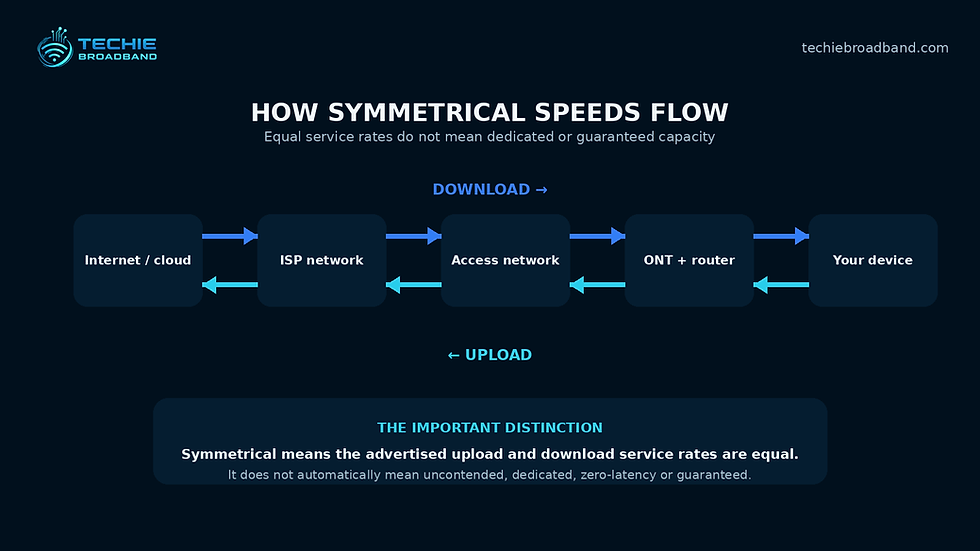
This is one of the most important distinctions. A symmetrical service can still use shared infrastructure. Equal upstream and downstream product rates do not tell you how many users share capacity, how the ISP manages congestion, what the backhaul looks like or whether the rate is guaranteed.
Ofcom defines a symmetric connection as one with equal upload and download speeds. It separately defines a dedicated connection as one reserved for one user with fixed bandwidth. Those are different properties.
Symmetrical: equal advertised upload and download rates.
Dedicated: capacity reserved for one customer.
Uncontended: the direct connection is not shared with other users.
Guaranteed speed: a contractual performance commitment, where one exists.
Throughput: the rate actually achieved in real conditions.
XGS-PON and symmetrical speeds
XGS-PON is particularly relevant because the underlying standard is physically symmetric. ITU-T G.9807.1 specifies a nominal 10 Gbit/s downstream rate and 10 Gbit/s upstream rate over a point-to-multipoint optical access network.
That does not mean every XGS-PON retail package must be sold as 10 Gbps symmetrical broadband. The access technology defines what the optical system can support. Network operators and ISPs still define retail and wholesale service profiles.
GPON is different
GPON supports several rate combinations, but the widely deployed profile is commonly 2.488 Gbit/s downstream and 1.244 Gbit/s upstream at the PON layer. That underlying asymmetry is one reason XGS-PON is significant for networks targeting higher symmetrical service tiers.
Again, PON line rates are shared access-system capacities. They should not be confused with the speed sold to one household.
UK symmetrical broadband in 2026
The UK full fibre footprint is now large enough for symmetrical broadband to be a mainstream consideration rather than a niche business-only feature. Ofcom's Spring 2026 Connected Nations update reported full fibre availability at 82% of UK residential premises and gigabit-capable availability at 89%.
Coverage does not mean symmetry is available from every ISP at every covered address. The correct comparison is always ISP + access network + product + location.
CityFibre and symmetrical broadband
CityFibre's current wholesale FTTH information lists 160 Mbps, 1 Gbps and 2.5 Gbps symmetrical services. Its 8.5 Gbps tier is currently listed with upload limited to 7 Gbps, which is a useful reminder that even a network built on symmetric XGS-PON does not require every commercial product profile to be exactly symmetrical.
CityFibre completed its nationwide XGS-PON network upgrade and has been expanding multi-gig wholesale services. What an end customer can actually order still depends on which ISP sells which profile at that address.
Openreach and XGS-PON
Openreach announced in August 2026 that it plans a wider XGS-PON rollout, building on its pilot and targeting more than one million premises over the following 12 months. It described potential speeds up to 8.5 Gbps.
The important technical distinction is that XGS-PON itself is symmetric at the optical layer. That does not automatically tell you what upload and download profile an Openreach communications provider will sell. Retail product specifications still need to be checked.
Does symmetrical broadband improve latency?
Not automatically. Symmetry is about capacity in each direction. Latency measures delay. A symmetrical connection can have poor latency, while an asymmetric connection can have excellent latency.
Where symmetry can help indirectly is under upstream load. A larger upload path takes more traffic to saturate, so normal household uploads may be less likely to fill queues. That can reduce the circumstances that trigger bufferbloat, but queue management still matters.
Symmetrical speeds and bufferbloat
A narrow upstream link is often easy to saturate. Start a cloud backup on a connection with limited upload capacity and queues can build quickly. Interactive traffic then waits behind bulk traffic, increasing latency under load.
A larger symmetrical upload gives the network more upstream headroom, but it does not eliminate poor queue management. Even a multi-gig connection can suffer bufferbloat if a bottleneck is saturated and queues are badly controlled.
Symmetrical speeds and gaming
Most games do not need hundreds of megabits of upload bandwidth. Symmetry therefore does not directly make a game respond faster. Gaming depends much more heavily on latency, jitter, packet loss and route quality.
The advantage appears when other activity shares the connection. A large cloud upload or backup is less likely to consume the entire upstream path when there is much more upload headroom available.
Symmetrical speeds for working from home
Remote work is one of the clearest residential use cases. Video conferencing itself is not especially bandwidth hungry, but a household may combine calls, VPN traffic, cloud synchronisation, source-control operations and large file transfers at the same time.
The benefit is not that every Teams or Zoom call suddenly needs gigabit upload. It is that upstream-heavy background work is less likely to compete with interactive traffic for a small upload allocation.
Symmetrical speeds for creators and cloud workflows
Video creators, photographers, developers and data-heavy home workers can benefit disproportionately. Their workflows often involve sending large datasets away from the premises rather than simply consuming content.
A 100 GB project uploaded at a theoretical 100 Mbps takes more than two hours. At a theoretical 1 Gbps it falls to just over 13 minutes. For repeated daily workflows, that difference is operational rather than cosmetic.
Symmetrical speeds for home servers and remote access
If you run services from home, the upload side of your broadband connection becomes the download side for the remote user. A home server behind a 1 Gbps download / 100 Mbps upload connection cannot serve a remote client at 1 Gbps just because the local package says gigabit broadband.
Symmetrical service can therefore make self-hosting, remote NAS access, media serving and off-site replication much more practical. Public addressing, CGNAT, firewall configuration and routing still matter independently. See the CGNAT guide for that separate issue.
Will WiFi deliver your symmetrical speed?
Possibly, but the broadband service and the local network are different layers. A 1 Gbps symmetrical WAN does not guarantee 1 Gbps in both directions over WiFi.
WiFi standard and channel width.
Signal strength and interference.
Client radio capability.
Access point capability.
Router processing performance.
Ethernet uplink speed.
Number of active devices.
Driver and operating-system behaviour.
For serious testing, use wired Ethernet with interfaces fast enough for the service tier. A 1 Gbps Ethernet interface will itself become a bottleneck on multi-gig broadband.
How to test whether your connection is really symmetrical
Connect a capable computer by Ethernet rather than relying on WiFi.
Confirm the negotiated Ethernet link rate is high enough for the broadband package.
Pause large background transfers and cloud synchronisation.
Run several reputable speed tests to nearby well-provisioned servers.
Record download and upload separately.
Repeat at different times of day.
Test latency while idle and again while upload and download are under load.
If results are consistently limited, check the router, ONT, Ethernet interfaces and ISP product profile before assuming an access-network fault.
A symmetrical product does not mean every individual speed test result must be numerically identical. Test server capacity, protocol overhead, congestion and local equipment can create variation.
Is symmetrical broadband always better?
Technically, having more upstream capacity gives you more flexibility. Whether it is worth paying more for depends on your workload.
A household that mostly streams video and browses the web may notice little difference between 1 Gbps / 100 Mbps and 1 Gbps / 1 Gbps. A creator moving hundreds of gigabytes to cloud storage may notice the difference every day.
What to check before buying a symmetrical broadband package
The exact advertised download and upload rates.
Whether those rates apply at your address and on your access network.
Whether the router has WAN and LAN ports fast enough for the tier.
Whether your switches and client devices support multi-gig Ethernet if needed.
Whether IPv4 uses CGNAT if inbound access matters.
Whether native IPv6 is provided if that matters to your setup.
Whether static IP options are available if required.
Any traffic management, fair-use or product restrictions.
Minimum guaranteed speeds or service commitments, if offered.
Whether the service is genuinely symmetrical or merely has a much faster upload than typical alternatives.
Symmetrical speeds FAQs
What are symmetrical broadband speeds?
They are broadband service rates where the advertised download and upload speeds are equal, such as 1 Gbps down and 1 Gbps up.
Is full fibre always symmetrical?
No. FTTP describes fibre reaching the premises. The ISP and access-network product profile determines the upload and download rates.
Is XGS-PON symmetrical?
At the physical access-system level, yes. ITU-T G.9807.1 specifies nominal 10 Gbit/s downstream and upstream operation. Retail products delivered over XGS-PON can still use lower or asymmetric service profiles.
Does symmetrical broadband reduce ping?
Not by definition. Ping measures latency. Symmetry describes the balance of upload and download capacity. More upstream headroom can reduce the likelihood of upload saturation affecting latency, but it does not guarantee lower baseline latency.
Do gamers need symmetrical broadband?
Usually not for the game traffic itself. Low and stable latency, low jitter and minimal packet loss matter more. Symmetrical capacity becomes useful when other devices are heavily uploading at the same time.
Who benefits most from symmetrical speeds?
People who regularly upload large files, use cloud backup, create video, work with remote storage, run home servers, replicate NAS data, livestream or have several upstream-heavy users sharing one connection.
Is a symmetrical connection dedicated?
No. Symmetry and dedication are separate properties. A symmetrical residential FTTP service may still share access and backhaul capacity with other customers.
The bottom line on symmetrical speeds
Symmetrical broadband removes the assumption that your internet connection should be fast in one direction and comparatively slow in the other. For ordinary download-heavy use that may not transform the experience. For cloud, creator, remote-work and self-hosted workloads, it can remove one of the most obvious bottlenecks in the connection.
But do not judge a connection by symmetry alone. Capacity, latency, jitter, packet loss, routing, congestion, addressing, local networking and the actual ISP product all still matter. Symmetrical speeds are one important part of a technically strong broadband connection, not a substitute for the rest of it.
To explore the related technical concepts used in this Symmetrical Speeds guide, visit our broadband terminology guide.
