
What is Peering?
Updated: 3 days ago

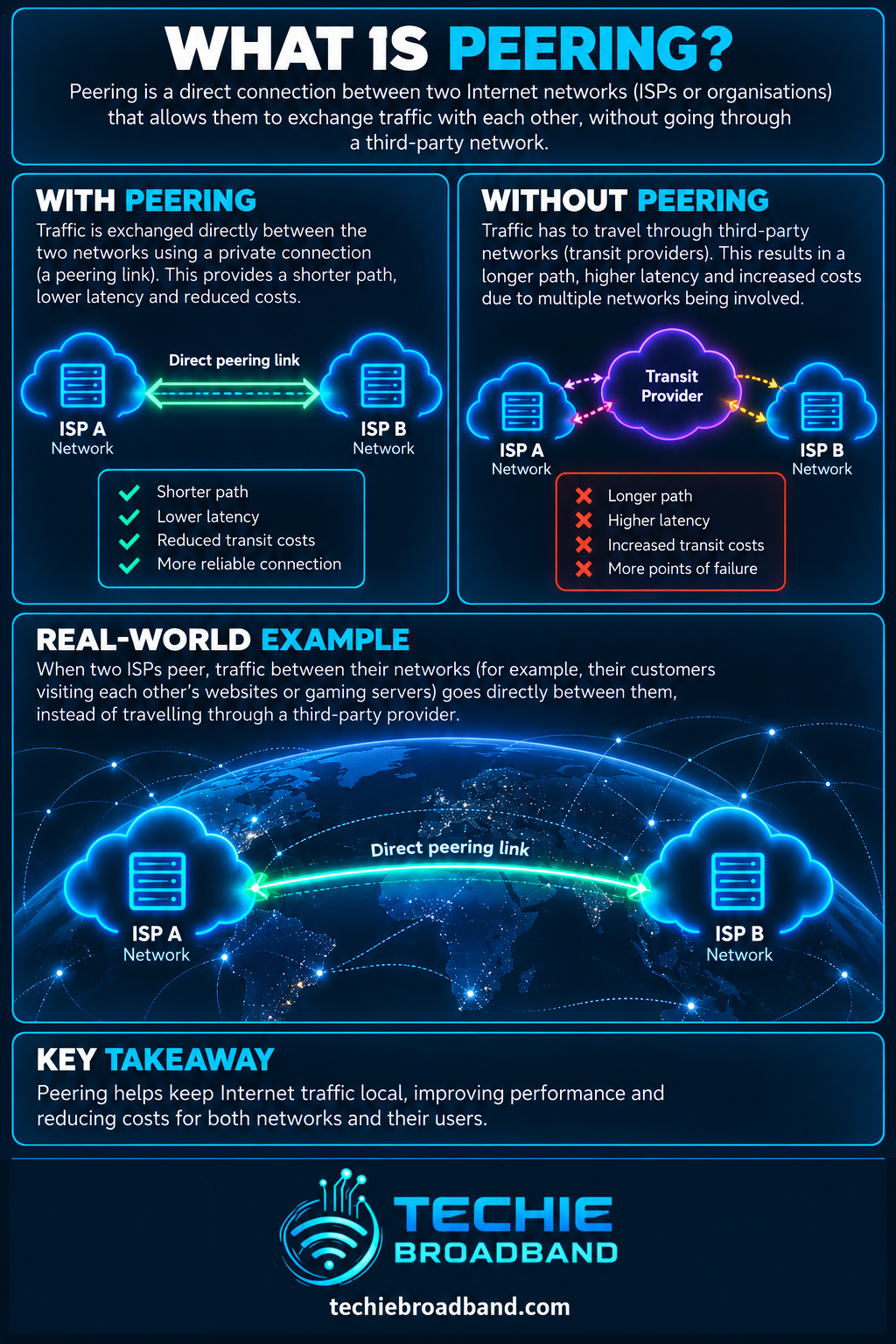
Peering is a direct interconnection relationship between two autonomous networks that exchange traffic for agreed IP prefixes, usually using BGP. Instead of sending that traffic through an upstream transit provider, the networks can hand it directly to each other at an Internet Exchange Point or private interconnection. For broadband users, peering matters because it can change the path, capacity, resilience and latency between an ISP and the services you actually use.
The crucial distinction is that peering is not the same as IP transit. Transit normally gives a network broader reachability to the internet through an upstream provider. Peering normally exchanges traffic only between the participating networks and the routes they agree to advertise.
How internet peering works
The internet is a network of autonomous systems. RFC 4271 defines BGP as the inter Autonomous System routing protocol used to exchange reachability information. A peering relationship gives two networks a way to exchange selected reachability information and then carry traffic directly between them.
Network A and Network B establish physical or virtual interconnection, either across an exchange fabric or through a private link.
Their edge routers establish BGP sessions, directly or through an IXP route server.
Each network advertises the IP prefixes it is willing to make reachable under the agreed policy.
BGP policy evaluates the available routes. A peering route can be preferred over a transit route, but that is a policy decision rather than an automatic rule.
User traffic is forwarded over the selected path until routing or policy changes.
Peering therefore has two related layers: the physical or Layer 2 interconnection that makes the networks reachable to each other, and the BGP routing relationship that decides which destinations are exchanged across it.
Peering versus transit
Peering and transit can both move packets between networks, but the commercial and routing relationships are different. A useful mental model is that transit buys wider internet reachability, while peering creates direct reachability for an agreed set of networks and prefixes.
Peering: two networks exchange selected traffic directly under an agreed routing and commercial policy.
Transit: one network provides another with reachability beyond its direct relationships and carries traffic onwards towards the wider internet.
Peering plus transit: most real networks use a mixture. Peering is not a complete replacement for transit unless the network has some other way to reach every destination it needs.
The word direct also needs care. A direct BGP relationship does not mean the two routers are physically adjacent, and it does not guarantee the geographically shortest route. Remote peering can extend an exchange connection across a transport provider, while private peering may cross a data centre fabric or dedicated circuit.
What is an Internet Exchange Point?
An Internet Exchange Point, or IXP, provides shared infrastructure where multiple independent networks can interconnect. LINX explains that ISPs, content networks, cloud platforms and enterprises can exchange traffic directly at an exchange rather than relying entirely on third party paths.
At an IXP, a network can connect one port to the exchange fabric and potentially establish BGP relationships with many other participants. The exchange itself is not normally acting as an IP transit provider for member traffic. It provides the interconnection environment in which members peer.
Bilateral peering and route servers
With bilateral peering, two networks establish BGP sessions directly with one another. At a large IXP, maintaining separate sessions with many networks creates operational overhead. LINX route servers allow members to exchange routes with many participating networks through a smaller number of BGP sessions.
A route server distributes routing information. It is important not to picture it as a router carrying all the user traffic. The data plane can still flow directly between the member networks across the exchange fabric while the route server helps with the control plane exchange of routes.
Public peering versus private peering
Public peering: networks connect across a shared IXP fabric. This is scalable because one exchange connection can provide access to many potential peers.
Private peering: two networks establish dedicated interconnection, often where traffic volumes, capacity, control or resilience justify it.
Remote peering: a network reaches an IXP through another connectivity provider instead of having equipment physically present at the exchange location.
Large networks often use all three approaches. The right design depends on traffic volume, geography, port and transport costs, capacity requirements, resilience objectives and the peering policies of the networks involved.
Why networks peer
Reduce dependence on paid upstream transit for traffic that can be exchanged directly.
Increase routing control by choosing where traffic enters or leaves another network.
Add path diversity and resilience alongside transit relationships.
Place more capacity close to high volume destinations.
Potentially reduce latency by avoiding unnecessary intermediate networks.
Keep some traffic more local or regional when both networks interconnect nearby.
None of those benefits is automatic. A poorly placed exchange, congested port, remote transport circuit or suboptimal BGP policy can make a peering path worse than a good transit path. Peering gives operators another path and more control. Engineering determines whether that path is actually better.
Does peering reduce latency?
It can, but fewer autonomous systems do not guarantee lower latency. Physical distance, fibre routes, queueing, exchange location, interconnection capacity and the destination's own network all affect round trip time.
A direct peer in London can be extremely useful when both networks already carry traffic through London. But if a user and service are in another region, forcing traffic through London merely because a peering session exists could create an unnecessary detour. BGP policy and network topology matter more than the word peering by itself.
Does peering increase broadband speed?
Peering does not change the access line rate sold to your home. A 500 Mbps FTTP service does not become 1 Gbps because the ISP peers with a content network. The distinction is the same one explained in our guide to bandwidth: access capacity and end to end application performance are related but not identical.
Peering can still affect real performance. If an interconnection path is congested, traffic to a particular service may slow even though the broadband access link is healthy. Adding peering capacity or moving traffic to another route can remove that bottleneck without changing the customer's package.
Techie Broadband practical capacity example
Consider a theoretical ISP with a 100 Gbps peering connection to a content network. If traffic towards that peer reaches 92 Gbps during a busy period, the port is at 92% utilisation. That leaves 8 Gbps of nominal line rate headroom before the 100 Gbps interface rate is reached.
Techie Broadband calculation: 92 ÷ 100 × 100 = 92% utilisation. This is a capacity example, not a claim about any real ISP. Operators normally engineer around traffic patterns, redundancy, burst behaviour, maintenance scenarios and failover rather than waiting for a link to sit permanently at 100%.
If packets are dropped during congestion, users may experience retransmissions or application disruption. That is different from the underlying access speed and is why packet loss must be considered separately from headline Mbps.
UK peering: LINX and LONAP
The UK has major internet exchange infrastructure. As of October 2026, LINX publishes live exchange traffic in the multi terabit per second range across its exchange footprint. Its public network information says more than 950 ASNs from over 80 countries connect to the LINX network.
LONAP is another London based IXP. Its public traffic page reports that its network switches more than 1 Tbps at peak. These are exchange level figures, not broadband speed measurements and not a measure of one ISP's total traffic.
For a UK broadband customer, the practical point is that the ISP's access network is only the beginning of the path. After traffic reaches the ISP core, the operator still needs effective interconnection with content networks, cloud platforms, CDNs, gaming networks and other ISPs.
Peering policies: open, selective and restrictive
Networks do not have to peer with everyone who asks. Operators publish or privately apply peering policies based on traffic volumes, geographic presence, capacity, routing hygiene, traffic ratios, redundancy and operational requirements.
Open policy: generally willing to peer with networks that meet basic technical requirements.
Selective policy: peering is considered when defined technical or commercial criteria are met.
Restrictive policy: the network peers only in limited circumstances or with strategically important partners.
A presence at the same IXP therefore creates an opportunity to peer, not a guarantee of peering. Route server participation can simplify multilateral relationships, but networks still apply routing policy and can control which routes are exchanged.
How BGP decides whether peering is used
BGP is policy driven. Operators can influence route selection using attributes such as LOCAL_PREF, AS_PATH and MED, along with communities and internal policy. The shortest AS path is not necessarily the route a network selects.
A common design is to assign customer routes the highest local preference, peering routes next and transit routes lower. But that is an operational convention, not a protocol requirement. Each autonomous system can implement its own policy.
Can peering go wrong?
Insufficient interconnection capacity can create congestion at busy times.
Route leaks or incorrect advertisements can send traffic somewhere it should not go.
A failed exchange port or transport circuit can remove a path until routing converges.
Asymmetric routing can make forward and return paths look very different.
A route server or bilateral policy mistake can suppress or unexpectedly prefer routes.
Remote peering transport can introduce a hidden bottleneck before traffic reaches the exchange.
LINX reported in 2024 that it enabled RFC 9234 route leak prevention on its route servers. This is a useful example of the controls IXPs and operators can deploy to reduce routing mistakes, but it does not eliminate every possible BGP incident.
How can a broadband user tell whether traffic is peered?
There is no perfect consumer speed test that simply says peered or not peered. Traceroute, ASN lookup tools, public looking glasses and PeeringDB can provide clues, but each has limitations. Router names may be ambiguous, ICMP replies can take different paths, and a commercial relationship cannot always be inferred from a traceroute.
Run traceroute or MTR to the destination from a wired connection.
Identify the public IP addresses and autonomous systems visible in the path.
Check whether the ISP and destination network share an exchange or known interconnection location.
Compare the route at different times and, where possible, use public looking glasses from other networks.
Treat the result as routing evidence, not proof of the commercial peering agreement.
Peering, CDNs and content caches
Direct peering is only one way to bring content closer. Large content providers may also deploy caches inside an ISP network or use regional CDN nodes. In that case some traffic can remain inside the ISP or travel only a short distance before reaching the content platform.
This is why two broadband providers using the same underlying FTTP access network can deliver different performance to the same online service. Their backhaul, core routing, caching, peering, transit and capacity engineering can all differ after the access network hands traffic over.
Peering and resilience
Peering can improve resilience when it adds genuinely independent paths. An ISP might peer with a content network at two exchanges while also retaining transit routes. If one interconnection fails, BGP can withdraw the affected routes and another valid path can become preferred.
True resilience depends on physical diversity as well as routing diversity. Two logical sessions carried over the same fibre route, switch or data centre dependency may fail together.
Peering misconceptions
Peering means free traffic. Not necessarily. Settlement free peering exists, but exchange ports, cross connects, transport, equipment and private interconnects all have costs, and some relationships can be paid.
Peering always means lower latency. No. It can create a shorter or better path, but topology and policy decide the outcome.
More peers always means a better ISP. Peer count alone says little about capacity, location, routing quality or the destinations customers actually use.
An IXP carries the whole internet. An exchange fabric connects participants. Each network still needs routes to destinations it cannot reach through its peering relationships.
Traceroute proves a commercial relationship. It can reveal path clues, but not the full contract or routing policy behind them.
What peering means when choosing a UK broadband provider
Consumers rarely need to choose an ISP by counting peers. A more useful question is whether the provider has enough capacity and sensible interconnection for the services you use, particularly at busy times.
Technically demanding users may value providers that publish network information, operate their own autonomous system, participate at multiple IXPs, provide IPv6, maintain diverse transit and peering, and communicate openly about incidents. But no single feature guarantees end to end performance.
Frequently asked questions
What is peering in simple terms?
Peering is when two independent networks connect and exchange traffic directly for agreed destinations instead of sending that traffic through an upstream transit provider.
Is peering the same as BGP?
No. BGP is the routing protocol used between autonomous systems. Peering is the interconnection relationship. BGP is commonly the mechanism used to exchange routes across that relationship.
Is peering free?
Not always. Some peering relationships are settlement free, but networks still incur costs for exchange membership, ports, cross connects, transport, routers and operations. Private or paid arrangements can also exist.
Does peering make gaming faster?
It can improve the path to a game network if it reduces distance, congestion or unnecessary intermediate networks. It cannot fix WiFi problems, access network delay, an overloaded game server or a distant server location.
What is an IXP?
An Internet Exchange Point is shared interconnection infrastructure where independent networks can connect and exchange traffic with one another.
What is a route server?
A route server helps IXP participants exchange BGP routing information with many networks without maintaining a separate bilateral BGP session with every participant. It generally supports the control plane rather than forwarding the member traffic itself.
Does every ISP use peering?
Peering strategies vary. Some networks peer extensively, some rely more heavily on transit, and many combine peering, transit and caching. The mix can also vary by region and destination.
Key takeaway
Peering is one of the mechanisms that turns separate autonomous networks into the interconnected internet. It can reduce dependence on transit, create more direct paths, add capacity and improve resilience, but the result depends on where networks interconnect, how much capacity exists and how BGP policy selects routes. For a UK broadband user, good peering is invisible when it works: traffic simply reaches important services through an efficient, uncongested path.
To explore the related technical concepts used in this Peering guide, visit our broadband terminology guide.
