
What is Transit?
Updated: 3 days ago

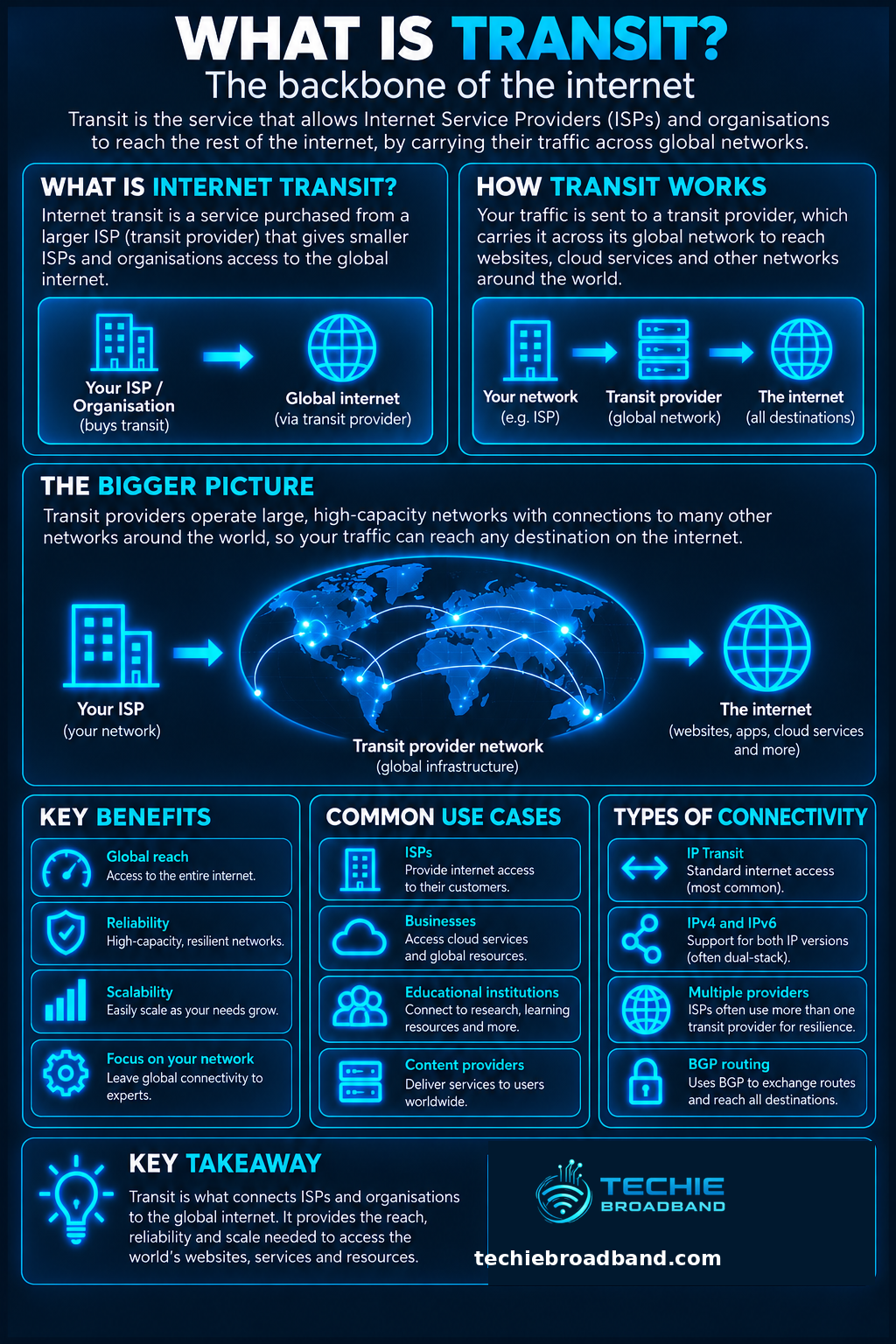
Transit, usually called IP transit in this context, is a service that gives one network reachability to destinations beyond its own direct connections. A customer autonomous system connects to a transit provider, exchanges routing information using BGP, and pays that provider to carry traffic towards the wider internet and to make the customer's prefixes reachable from other networks. The important distinction is that transit is a routing and connectivity relationship between networks. It is not the same thing as broadband speed, bandwidth, peering or simply moving packets across a local network.
For a UK broadband user, transit normally sits well beyond the home router and access line. You may never see the commercial transit relationship, but the routes and capacity chosen by an ISP can influence which networks your traffic crosses, how resilient the path is, and where a wider network bottleneck could appear.
What does transit mean on the internet?
The internet is not one network. It is an interconnection of independently operated networks called autonomous systems, or ASes. The IETF's BGP 4 specification describes an autonomous system as routers under a single technical administration that present a coherent routing view to other autonomous systems.
Transit describes the case where a network agrees to carry traffic between other networks rather than carrying only traffic that originates or terminates inside itself. The IETF's BGP application guidance distinguishes local traffic from transit traffic and describes a transit AS as an autonomous system designed, subject to policy, to carry both.
A customer network needs reachability beyond the networks it connects to directly.
A transit provider supplies routes towards those destinations.
The provider can advertise the customer's prefixes to other networks.
Traffic can then cross the provider's network on the way between separate autonomous systems.
IP transit in one sentence
IP transit is a commercial network service in which a provider carries a customer's internet traffic beyond directly connected networks and supplies routing reachability to the wider internet.
How IP transit works
At the technical level, transit depends on routing information and packet forwarding. The customer and provider commonly use Border Gateway Protocol, BGP, to exchange reachability information between autonomous systems. BGP does not make the physical link faster. It tells networks which IP prefixes can be reached through which routing paths and allows policy to influence the selected route.
The customer connects to the transit provider at one or more physical or logical interconnection points.
The customer tells the provider which IP prefixes it is authorised to originate, subject to the agreed routing policy.
The provider advertises appropriate reachability onwards to other networks.
The provider sends the customer routes, often including a full internet routing table or a selected set plus a default route, depending on the service.
Traffic follows the selected BGP paths and is carried across one or more autonomous systems towards its destination.
The exact commercial and technical arrangement varies. Transit may be bought at one location, multiple data centres or several geographically diverse points. A network can also buy transit from more than one provider.
What is an autonomous system?
An autonomous system is a network or group of networks operated under a coherent routing policy and identified to interdomain routing by an Autonomous System Number, or ASN. BGP exchanges routes between these systems. An ISP, content network, cloud provider, enterprise or transit carrier may operate one or more ASes.
This matters because transit is fundamentally an AS to AS relationship. Thinking only in terms of websites, broadband packages or physical cables hides the routing layer that decides how independently operated networks reach one another.
Transit vs peering
Transit and peering both connect networks, but they solve different reachability problems.
Transit: one network buys broader internet reachability from another network that will carry its traffic onwards.
Peering: two networks exchange traffic directly for agreed routes, commonly traffic belonging to themselves and their customers, rather than one side automatically providing full internet reachability.
Private interconnection: a physical or logical connection can support peering, transit or another commercial relationship. The cable itself does not define the routing relationship.
Peering is therefore not automatically a substitute for transit. A network could peer with many major content networks yet still need transit to reach the rest of the internet. Commercial peering arrangements also vary, so 'peering' should not be treated as synonymous with 'free'.
The infographic below summarises the distinction and the role BGP plays.
Transit vs bandwidth and throughput
Transit is also different from bandwidth. Bandwidth describes capacity. Transit describes a network reachability service. A 10 Gbps transit port, for example, describes an interface or contracted capacity associated with the service, but 'transit' itself is not a unit of speed.
Likewise, throughput is the realised data rate during a measurement. A network can have valid transit routes while achieving poor throughput because a link, interface, queue, remote server or another section of the end to end path is constrained.
What routes does a transit customer receive?
A transit customer does not have to receive routing information in only one form. The design depends on the network, router resources and service. Common approaches include a default route, selected routes, or a full BGP routing table.
Default route: send destinations not known more specifically towards the transit provider. Simple, but provides less path information to the customer.
Selected routes: the provider supplies a subset of routes according to the service design.
Full routes: the customer receives broad global BGP reachability information and can make more detailed routing decisions, particularly when multihomed.
Receiving more routes does not automatically improve performance. It creates more information on which routing policy can act, but path quality still depends on topology, capacity, policy, congestion and the networks beyond the customer's control.
What does a transit provider advertise?
In the opposite direction, the customer normally advertises its authorised prefixes to the transit provider. The provider can then propagate appropriate reachability onwards. Route filtering is critical because an incorrect advertisement can affect traffic far beyond the originating network.
The IETF's BGP Operations and Security guidance covers operational practices such as filtering and notes the significance of routing policy between autonomous systems. Transit is therefore not merely 'plug in a cable and send traffic'. It is a controlled routing relationship.
What is a Tier 1 transit provider?
The term Tier 1 is commonly used for a network that can reach the internet without purchasing transit from another provider. RFC 7454 defines a Tier 1 transit provider as an IP transit provider able to reach any network on the internet without buying transit services. That does not mean every route is physically direct. It means the network's combination of customer routes and settlement relationships provides the required reachability.
Tier labels are industry shorthand rather than a measure of the broadband speed an end user receives. A residential connection does not become faster merely because a particular upstream network is described as Tier 1.
Why would an ISP use more than one transit provider?
Using multiple upstreams can improve resilience and routing choice. If one provider or interconnection fails, policy may allow traffic to move to another available path. Multiple providers can also expose different paths to destinations and reduce dependence on one commercial relationship.
However, multihoming is not magic redundancy. Shared fibre routes, shared facilities, router failures, configuration errors and common downstream dependencies can still create correlated failures. Genuine resilience requires examining the complete physical and logical path.
Where transit sits in a UK broadband connection
A typical home broadband path can include the device, WiFi or Ethernet, router, ONT or modem, access network, ISP aggregation and core, external interconnection, one or more other networks, and the remote service. Transit can be one of those external interconnection relationships, but not every packet necessarily uses paid transit.

An ISP may reach some destinations through direct peering, some through private interconnection, some through an internet exchange and others through transit. The actual route can differ by destination, IP version, location and routing policy.
Does all broadband traffic use transit?
No. If an ISP has a direct route to a destination network through peering or another interconnection, traffic may never cross a paid transit provider. Other destinations may require transit. This is one reason two services using the same access technology can still take different wider internet paths.
Can transit affect latency?
Transit can influence latency because routing determines part of the physical and logical path packets take. A route that travels through more distant interconnection points can have a higher latency or round trip time. But the word transit alone does not tell you whether a route will be fast or slow.
Propagation distance, router processing, queueing, interconnection location, congestion and the remote service all matter. A direct peering path can be excellent, but a well engineered transit route can also perform extremely well.
Can transit become congested?
Yes, but it is important to identify the actual constrained resource. Network congestion occurs when offered traffic exceeds the capacity available at a resource for long enough to create queueing, delay or loss. That resource could be a transit interconnection, but it could equally be the access network, ISP core, home WiFi, remote service or another link.
A slowdown to one destination therefore does not prove that an ISP has insufficient transit. Diagnosis needs comparison across destinations, times and paths.
Transit capacity and utilisation
Transit services are often discussed in capacity terms such as Gbps, but capacity and utilisation must remain separate. Consider a theoretical example.
Techie Broadband calculation: suppose a network has two independent 100 Gbps transit connections and, for a simplified capacity illustration, both are technically available for traffic. The headline installed transit capacity is 200 Gbps. If measured aggregate transit traffic at a particular instant is 120 Gbps, aggregate utilisation against that simplified installed figure is 120 ÷ 200 = 60%.
That does not prove each link is 60% utilised. Routing policy could place 90 Gbps on one provider and 30 Gbps on the other. Nor does it prove 80 Gbps of perfectly usable headroom exists for every destination. Routes, per port limits, traffic direction and downstream bottlenecks matter.
Why peak utilisation matters more than a single average
A monthly or daily average can conceal short periods of high utilisation. If a transit link is lightly used overnight but approaches its capacity during the busy evening period, an all day average may look comfortable while users still experience peak time effects. Capacity planning therefore needs time series data and per interconnection visibility, not just one percentage.
Transit and route selection
BGP route selection is policy driven. Networks can prefer one upstream, alter local preference, prepend AS paths, use communities and apply other policies to influence inbound or outbound routing. The shortest geographic path is not automatically selected.
This also explains why a traceroute can appear to take an unintuitive path. Commercial relationships and routing policy shape the internet alongside physical geography.
Transit and IPv4 versus IPv6
IPv4 and IPv6 are separate routed address families. A network may have excellent IPv4 reachability and a different set of IPv6 upstreams or policies. When diagnosing an apparently destination specific problem, testing both protocols can reveal whether the behaviour belongs to one routing path rather than the broadband line generally.
Transit, CGNAT and static IP addresses
Transit should not be confused with how an ISP addresses an individual broadband customer. CGNAT, public IPv4, static IPv4 and IPv6 delegation are customer addressing and service design choices. Transit is about how networks obtain and provide wider reachability. An ISP can use upstream transit regardless of whether an individual retail customer receives CGNAT or a static address.
Does better transit mean faster broadband?
Not necessarily. A well provisioned and well connected ISP can improve the wider network component of performance, but your final experience is end to end. The access product, WiFi, router, device, remote service and destination network can all constrain performance.
A 1 Gbps broadband package also cannot exceed a 1 Gbps local bottleneck merely because the ISP has enormous upstream transit capacity. Conversely, a multi gigabit local network cannot compensate for congestion at an external interconnection.
How to investigate a possible wider network or transit problem
Test over wired Ethernet so local WiFi variation does not dominate the result.
Confirm the device and router are negotiating the expected interface rate.
Measure performance to several well provisioned test destinations.
Compare multiple real services rather than relying on one speed test server.
Measure latency and packet loss alongside throughput.
Repeat tests at quiet and busy times.
Compare IPv4 and IPv6 where both are available.
Use traceroute or equivalent path information carefully to identify major routing changes, while remembering that intermediate routers may rate limit or deprioritise diagnostic replies.
Check whether the issue affects one destination, one group of networks or almost everything.
Only after local causes are excluded should you treat upstream routing, peering or transit capacity as a strong suspect.
Common transit misconceptions
Transit means internet bandwidth
Not exactly. A transit service is a reachability and traffic carriage relationship. It has capacity, but capacity and transit are not interchangeable terms.
Every packet from my ISP uses transit
No. Direct peering and other interconnections can keep traffic away from a paid transit path.
More transit providers always means better performance
Not automatically. Diversity can improve resilience and routing options, but engineering, capacity, policy and physical diversity determine the result.
The shortest AS path must be the fastest
No. AS path length is not geographic distance and does not expose every performance characteristic of the route.
A transit problem is the same as an access line fault
No. A broadband access fault and an upstream routing or interconnection problem occur at different parts of the end to end path and can produce different patterns of symptoms.
Frequently asked questions
What is IP transit?
IP transit is a service where one network provides another network with reachability to destinations beyond its direct connections and carries traffic onwards across the internet.
Is transit the same as peering?
No. Transit generally provides broader paid reachability, while peering is a direct routing relationship for agreed traffic between networks. The commercial terms and route scope can vary.
What protocol is used for internet transit?
BGP is the standard interdomain routing protocol used to exchange reachability information between autonomous systems. The actual user traffic is then forwarded according to the resulting routing decisions.
Can an ISP have several transit providers?
Yes. Networks commonly use multiple upstream relationships for resilience, routing choice and capacity, although the exact design differs by operator.
Can I see my ISP's transit provider with traceroute?
Sometimes you can infer parts of the path from router names, IP ownership and AS information, but traceroute is not a complete representation of commercial relationships and some routers do not respond predictably to probes.
Does transit affect gaming latency?
It can, because wider internet routing contributes to the end to end path. But local WiFi, access network latency, server location, congestion and game infrastructure can matter just as much or more.
Key takeaway
Transit is the mechanism by which a network can buy wider internet reachability from another autonomous system. It is a routing and connectivity relationship, normally built around BGP, not another name for broadband speed. Understanding transit alongside peering, autonomous systems, bandwidth, throughput and latency makes it much easier to see why the internet behaves as a network of networks rather than one giant network.
To explore the related technical concepts used in this Transit guide, visit our broadband terminology guide.
