
What is Burst Speed?
Updated: 3 days ago

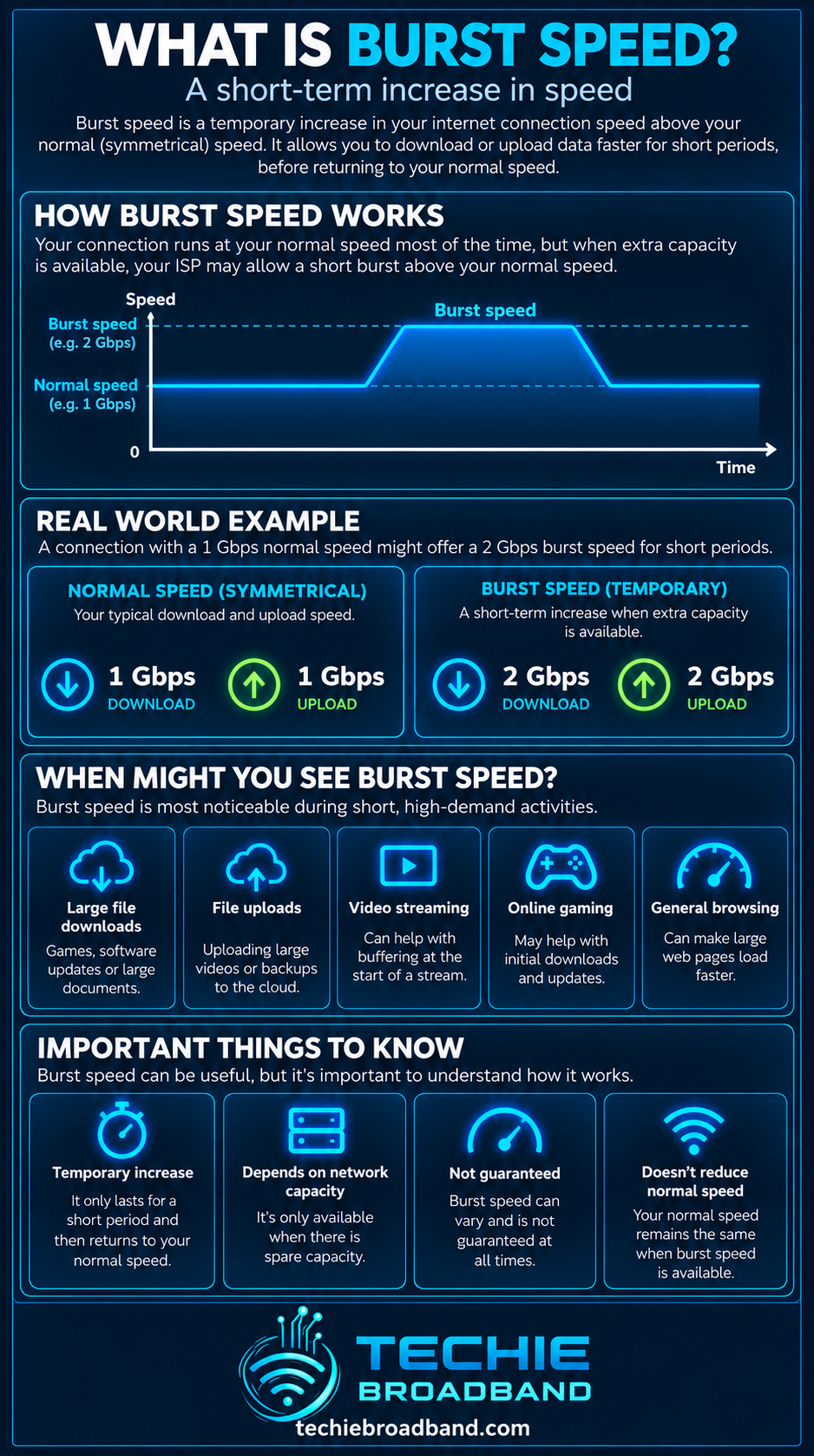
Burst speed is the data rate a connection, device or network path can achieve for a short period rather than the rate it can maintain indefinitely. In broadband testing it can describe a brief measured peak. In traffic shaping it can describe temporary permission to exceed a sustained or committed rate. The important distinction is simple: burst speed is short term performance, not proof of sustained throughput.
That distinction matters because a connection can look extremely fast during the first few seconds of a test or transfer and then settle to a lower long term rate. For small objects the burst may be genuinely useful. For large downloads, cloud backups and continuous workloads, sustained throughput and goodput usually matter more.
What does burst speed mean?
There is no single universal broadband definition that applies to every speed test, ISP and traffic policy. The phrase is used in several related ways, so any burst result needs context: what was measured, over what interval, and whether a network policy deliberately allows a temporary higher rate.
The Techie Broadband terminology guide defines burst speed as a short period where a connection exceeds its sustained throughput capacity. That is a useful practical definition, but the mechanism behind the burst still matters.
Burst speed versus sustained throughput
Bandwidth describes capacity. Download speed describes the rate at which data is received. Sustained throughput describes what the path can continue delivering over a meaningful period. Burst speed focuses on a shorter interval.
A burst can be higher than the later sustained rate.
A sustained rate can remain almost flat, in which case there may be no meaningful burst to separate from it.
A very high first second result can be a measurement artefact rather than usable network capacity.
A burst does not automatically mean an ISP is deliberately boosting a retail broadband product.
Burst speed in broadband speed tests
thinkbroadband describes its burst speed figure as the speed a computer and connection sustained for a short period during the test. Its guidance also warns that unusually high figures at the start can be caused by security software delaying traffic and then releasing buffered data.
This is why a burst number should never be read in isolation. Test duration, single versus multiple connections, server capacity, local WiFi, caching, security software and the measurement interval can all affect what appears at the start of a test.
Burst speed can also be a traffic policy
In managed networks, burst behaviour can be intentional. A service may have a normal or committed rate and a higher peak rate that is permitted only while a burst allowance is available. The exact implementation depends on the network equipment and policy.
IETF traffic models use concepts such as committed and peak information rates together with burst sizes. This is the technical family of ideas behind many rate limiting and traffic shaping systems, although a consumer ISP using the phrase burst speed may implement it differently.
How token bucket style bursting works
A useful mental model is a bucket of permission. Tokens accumulate according to a configured rule. Sending traffic consumes those tokens. If enough tokens are available, a short transfer can run above the sustained rate up to a peak limit. Once the allowance is depleted, the flow settles toward the configured long term rate.
This is a model, not a claim that every UK broadband service uses a particular token bucket configuration. Network operators can police, shape and schedule traffic in different ways.

Techie Broadband calculation: what a burst changes
Consider an illustrative service that can burst to 1 Gbps for the first 20 seconds of a transfer and then sustain 500 Mbps. Assume decimal units, no protocol overhead and no other bottleneck.
10 GB = 80 gigabits of data.
The first 20 seconds at 1 Gbps transfers 20 gigabits.
60 gigabits remain.
60 gigabits at 500 Mbps takes 120 seconds.
Total theoretical transfer time is therefore 140 seconds.
Without the burst, the same 80 gigabits at a constant 500 Mbps would take 160 seconds. In this deliberately simplified example the burst saves 20 seconds, or 12.5 percent of the non burst transfer time.
Real transfers will differ because application goodput, protocol overhead, server performance, storage, congestion and other end to end constraints reduce or vary the useful rate.
Why burst speed can make browsing feel fast
Many web transfers are short. HTML, scripts, images and API responses often arrive in separate bursts with pauses between them. If a connection is allowed to use a higher rate during those active periods, some objects can complete before the sustained limit becomes relevant.
That does not mean every website becomes proportionally faster. Round Trip Time, DNS, TLS setup, server processing, browser work and the number of dependent requests can dominate page responsiveness.
Burst speed and TCP behaviour
TCP can naturally transmit data in bursts after application pauses or as congestion control changes the amount of data in flight. RFC 8337 explicitly discusses sender rate burst tests and notes that standard TCP behaviour can produce full window bursts after an application pause.
This is different from an ISP product deliberately offering a temporary higher service rate. It is also affected by Round Trip Time, congestion control, receive windows and the capacity of the bottleneck path.
Burst speed and goodput
Goodput counts useful application payload delivered over time. A connection can show a high burst at a lower measurement layer without the application receiving useful data at that same rate for long.
For a small transfer, the burst may materially improve goodput because the whole object finishes during the faster interval. For a large transfer, the long term result increasingly converges on the sustained end to end rate.
Burst speed and network congestion
Network congestion occurs when traffic demand exceeds available capacity at a resource. Bursts can temporarily increase queue pressure because a sender may inject traffic faster than a downstream bottleneck can forward it.
A well engineered network needs enough buffering, scheduling and capacity to handle normal burstiness without creating excessive delay or loss. Excessive buffering can hide packet loss while allowing latency to rise sharply.
Burst speed and peak time performance
Peak time performance asks a different question: how well does the broadband path hold up when networks are busy? A short burst measured at 2am cannot tell you whether sustained performance remains strong at 8pm.
When comparing broadband performance, repeat sustained tests at different times. A burst figure is useful context, but it should not replace longer tests that reveal contention, congestion or persistent bottlenecks.
Burst speed on FTTP, cable, fixed wireless and mobile
Burst behaviour is not tied to one access technology. FTTP, cable, fixed wireless and mobile networks can all carry bursty traffic, but their scheduling, shared capacity, radio conditions, service profiles and congestion characteristics differ.
Do not assume that an FTTP service, a GPON or XGS PON access network, or a particular UK ISP automatically provides a deliberate burst above the retail product rate. The relevant combination is ISP, access network, product and location.
Burst speed on WiFi
WiFi traffic is naturally variable because devices contend for airtime and the radio adapts its modulation and coding to conditions. A brief high result can be followed by a lower sustained rate because of interference, retries, distance, channel use or other devices competing for airtime.
For broadband diagnosis, test over wired Ethernet first. Otherwise a burst or dip may describe the local wireless link rather than the broadband service.
Why a burst can exceed the speed you expected
The test reports a very short sampling interval rather than a long average.
The service deliberately permits a temporary peak above a sustained policy.
Buffered traffic is released after antivirus or security inspection.
A browser, proxy or application cache changes what is actually traversing the broadband path.
Measurement timing or test implementation creates a short spike.
The headline product rate and the specific interface or access profile are being compared at different layers.
Why burst speed may equal average speed
thinkbroadband's testing guidance notes that if the graph is very flat there may be no discernible burst, so the average can be used. A flat result can simply mean the connection ran consistently during that test.
How long does a burst last?
There is no universal duration. A speed test may define burst speed using its own short measurement interval. A traffic shaper may allow a burst according to configured rates, thresholds and burst sizes. A transport protocol can produce bursts according to application and congestion control behaviour.
Any claim such as 'your burst lasts 20 seconds' is meaningless unless it refers to a specific product, policy or test methodology.
What matters more than burst speed?
Sustained throughput for large transfers and continuous workloads.
Goodput for the useful application payload actually delivered.
Latency and RTT for interactive responsiveness.
Jitter for consistency in real time traffic.
Packet loss and retransmissions for reliability.
Loaded latency when the connection is busy.
Peak time performance when shared networks are under heavier demand.
How to test burst speed properly
Connect a capable computer to the router using wired Ethernet.
Confirm the negotiated Ethernet rate is high enough for the broadband service.
Pause other downloads, uploads, backups and cloud synchronisation.
Run a test that exposes a time series or clearly distinguishes short burst and sustained results.
Record the initial peak, the later sustained rate and the test duration.
Repeat the test several times rather than relying on one spike.
Use a second test service or a large real file transfer for comparison.
Repeat at different times of day.
Check CPU, router, Ethernet and storage limits on multi gigabit services.
Only then repeat over WiFi if you want to measure the wireless path separately.
How to interpret a burst speed result
A burst result is strongest when it is repeatable and accompanied by a stable sustained result. If the first second is dramatically higher but every longer test settles much lower, treat the higher number as short term behaviour rather than the connection's normal application performance.
If the burst changes wildly between runs, investigate local software, WiFi, test servers and device limitations before drawing conclusions about the ISP.
Common burst speed misconceptions
A high burst speed does not prove a broadband line can sustain that rate.
Burst speed is not the same as bandwidth.
Burst speed is not the same as goodput.
A speed test spike is not automatically an ISP speed boost.
A lower sustained result is not automatically congestion.
A faster burst does not automatically reduce latency.
Multi gigabit broadband still needs capable router, Ethernet, device and storage hardware to expose high rates.
Frequently asked questions about burst speed
Is burst speed the same as maximum broadband speed?
Not necessarily. Burst speed describes short term performance. Maximum broadband speed may refer to a product ceiling, access profile, interface rate or advertised maximum. The measurement layer and time interval must be stated.
Is burst speed the same as throughput?
Burst speed can be a short throughput measurement, but throughput measured over a longer interval can be lower. Sustained throughput is normally more useful for large transfers.
Can an ISP deliberately provide burst speed?
Yes. Networks can be configured to permit temporary rates above a committed or sustained rate. That does not mean every consumer broadband product does so, and the exact policy must be verified for the specific service.
Can a speed test show a false burst?
Yes. Short sampling intervals, buffering, caching, security software and test implementation can produce an initial spike that does not represent sustained network capacity.
Does burst speed matter for gaming?
Usually far less than latency, jitter and packet loss. Game traffic normally needs modest bandwidth. A higher temporary transfer rate may help updates or downloads but does not by itself improve in game responsiveness.
Does burst speed help web browsing?
It can help some short transfers finish sooner, but page responsiveness also depends on RTT, DNS, server processing, connection setup and browser work. The benefit is workload dependent.
Should I use burst speed to compare broadband providers?
Not on its own. Compare sustained download and upload performance, latency, loaded latency, peak time behaviour, reliability and the capabilities of the specific product available at your address.
The key point
Burst speed tells you what happened briefly. Sustained throughput tells you what the path can keep doing. For small transfers a genuine burst can be useful, but for large downloads, uploads and continuous workloads the long term rate, goodput, latency and congestion behaviour give a much better picture of real broadband performance.
