
What is Sustained Throughput?
Updated: 3 days ago

Sustained throughput is the data rate a network connection can continue delivering over a meaningful period once short start-up effects have passed. It matters because a broadband connection that briefly reaches a high speed is not necessarily capable of holding that rate during a large download, backup, software update or other long transfer.
The key distinction is duration. Burst speed describes a short-lived rate. Sustained throughput asks what the end-to-end path can keep moving after the initial ramp-up, while Goodput goes a step further and counts the useful application payload delivered.
Sustained throughput in one sentence
Sustained throughput is the measured rate of successful data transfer that can be maintained across a network path for long enough to represent steady performance rather than a momentary spike.
Bandwidth, throughput, sustained throughput and goodput
Bandwidth is capacity. Throughput is the rate data is actually transported. Sustained throughput focuses on the rate maintained over time. Goodput focuses on useful application payload after protocol overhead and retransmitted data are excluded.
Bandwidth: the capacity available to carry traffic.
Line or interface rate: the signalling or negotiated rate of a link.
Throughput: data successfully transported per unit of time at the layer being measured.
Sustained throughput: throughput maintained over a meaningful steady-state interval.
Goodput: useful application payload successfully delivered per unit of time.
Those figures can all be different on the same connection. A 1 Gbps Ethernet interface does not imply 1 Gbps of sustained TCP throughput, and sustained TCP throughput does not imply the application receives useful payload at exactly that rate.
How sustained throughput is measured
A useful sustained throughput test transfers enough data for long enough to move beyond connection setup, TCP slow start, caching effects and very short bursts. The exact duration is not universal. It needs to be long enough to expose the behaviour of the path being tested.
RFC 6349 defines a framework for testing sustained TCP-layer performance and describes achievable TCP throughput as the amount of data TCP transports per unit of time when it reaches equilibrium. The framework considers path MTU, Round Trip Time, bottleneck bandwidth, TCP windows and loss.
That does not mean every home broadband speed test implements RFC 6349. It does provide an important technical principle: sustained performance is a steady-state property, not the highest number observed for an instant.
Why sustained throughput can be lower than the advertised speed
A broadband package speed describes the retail service or access rate under defined conditions. Sustained end-to-end throughput also depends on everything between the test device and the remote server.
Protocol framing and encapsulation consume part of the raw link capacity.
TCP behaviour depends on latency, loss, congestion control and receive windows.
Network congestion can reduce the rate available at busy resources.
WiFi contention, retries and radio conditions can constrain the local path.
Router, firewall or VPN processing can become a bottleneck.
Ethernet interfaces can cap faster broadband tiers.
The remote server or interconnection can be slower than the access service.
Device CPU and storage can limit very fast transfers.
This is why the narrowest relevant component on the end-to-end path matters.

Techie Broadband calculation: 10 GB transfer
The following is a theoretical Techie Broadband calculation using decimal units. A 10 GB file contains 80 Gb of data.
At a theoretical 1 Gbps payload rate: 80 Gb ÷ 1 Gbps = 80.0 seconds.
At 940 Mbps sustained throughput: 80,000 Mb ÷ 940 Mbps = 85.1 seconds.
At 900 Mbps application goodput: 80,000 Mb ÷ 900 Mbps = 88.9 seconds.
These are mathematical examples, not promises of real transfer times. Connection setup, protocol overhead, retransmissions, server performance, storage and other constraints can extend the result.
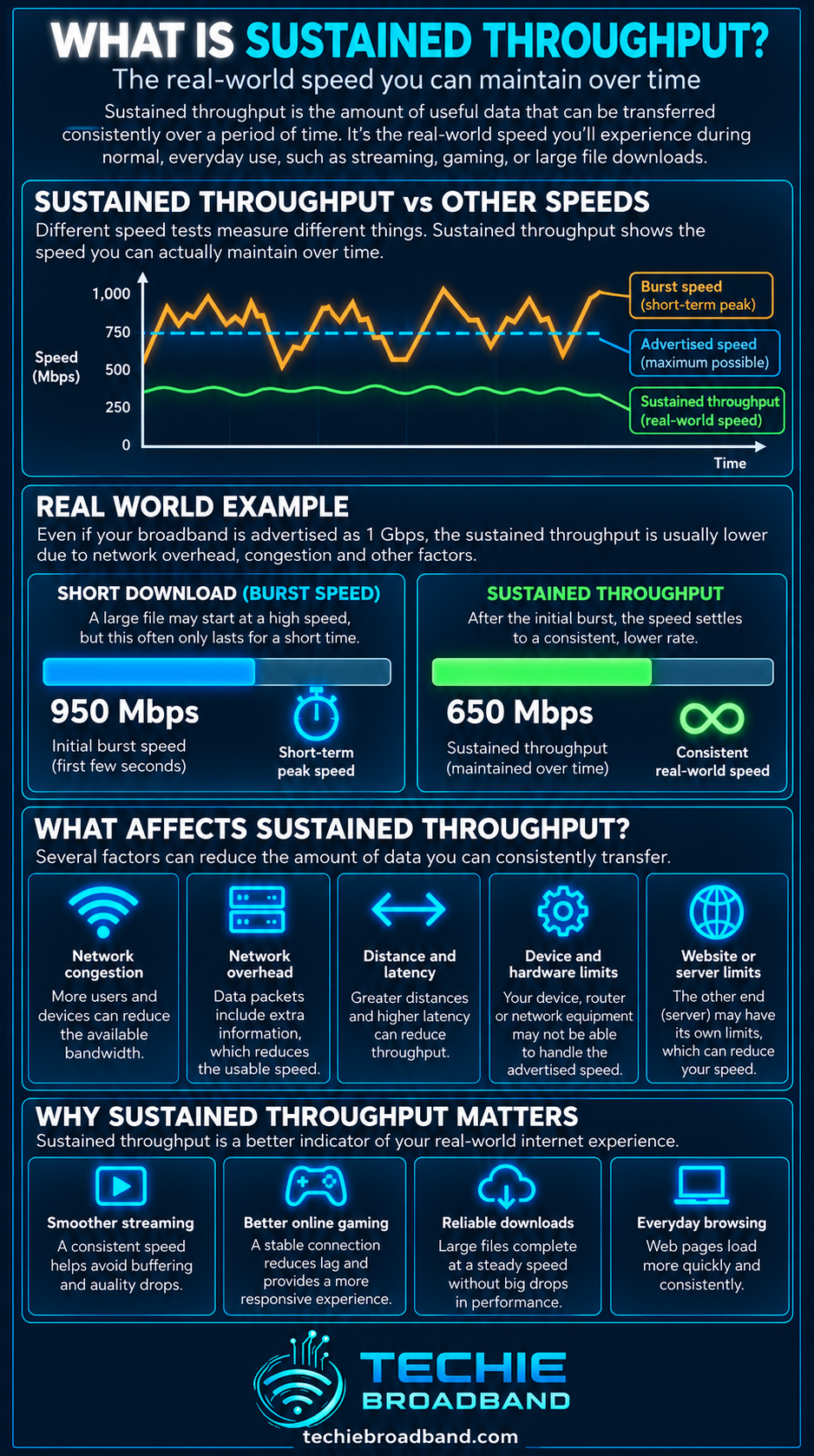
Sustained throughput versus burst speed
A short test interval can make a connection look faster than it can remain over a large transfer. A burst may be genuine, deliberately permitted by a traffic policy, or simply part of normal transport behaviour. Sustained throughput deliberately looks beyond that short interval.
For example, a connection might briefly transfer at 1 Gbps and then settle at 500 Mbps. A small object could finish during the fast period, while a 20 GB transfer would spend most of its time at the lower sustained rate. Neither number is necessarily false. They answer different questions.
Sustained throughput and TCP
TCP is designed to adapt its sending behaviour. At the start of a connection, the congestion window grows as TCP learns how much data the path can carry. Loss, delay and congestion signals can then alter the sending rate.
Round Trip Time matters because a sender can only receive acknowledgements after data crosses the path and the acknowledgement returns. On high-bandwidth, high-RTT paths, the amount of data that must be in flight to fully use the path can be large.
RFC 6349 uses the bandwidth-delay product when considering the socket buffer sizes needed to achieve maximum TCP throughput. A single TCP flow can therefore underuse a fast path when windows, loss or endpoint behaviour are limiting.
Sustained throughput and network congestion
Network congestion occurs when offered traffic exceeds the capacity available at a resource. Queues can build, latency can rise and packets may be dropped. TCP senders can respond by reducing their sending rate, which can lower sustained throughput.
This is one reason a connection can perform differently at different times. The access line itself may be unchanged while shared capacity elsewhere in the path is under different load.
What UK broadband data tells us
Ofcom's Connected Nations 2025 report says the UK average maximum residential download speed increased from 223 Mbit/s in 2024 to 285 Mbit/s in 2025 as full-fibre take-up increased. Ofcom also stopped reporting time-of-day performance in that report because the variation observed in 2024 was low enough to be of limited use for comparing services.
Earlier Ofcom embedded measurement data for March 2024 found average 8pm to 10pm download speeds from router to internet were between 98.7% and 99.7% of 24-hour averages across the technologies measured. Those are aggregate results, not a guarantee for an individual connection.
The practical lesson is that UK access speeds are becoming faster, but the sustained performance of your particular transfer still depends on the specific ISP, access network, product, location, home network and remote destination.
FTTP, GPON and XGS-PON
FTTP removes many of the copper-line limitations associated with older access technologies, but fibre access does not make the entire internet path dedicated to one household.
GPON and XGS-PON architectures can share optical capacity between premises. Providers also aggregate traffic deeper in their networks. Whether that sharing affects a particular user's sustained throughput depends on network design, provisioned capacity, traffic load and the product being used.
Do not assume that every FTTP service, every ISP or every location has the same sustained performance simply because the headline package speed is similar.
Why WiFi can hide broadband sustained throughput
A fast FTTP service can be constrained before traffic even reaches the router's WAN interface. WiFi is a shared radio medium. Signal strength, interference, channel width, neighbouring networks, client capabilities and retransmissions all affect the rate a device can sustain.
For diagnosing broadband rather than WiFi, start with wired Ethernet where practical. Ofcom similarly recommends an Ethernet-connected device when trying to obtain the most accurate possible broadband speed test.
Multi-gig broadband changes the bottleneck
On a 2.5 Gbps or faster broadband tier, equipment that was perfectly adequate for gigabit broadband can become the limiting component. A router may have a multi-gig WAN port but only gigabit LAN ports. A switch, Ethernet adapter or cable path can negotiate at 1 Gbps. Storage can also become relevant during large local or remote transfers.
As access speed increases, diagnosing sustained throughput becomes increasingly about the complete path rather than the broadband line in isolation.
How to test sustained throughput properly
Use a wired Ethernet connection where practical.
Confirm the negotiated Ethernet link speed on the test device.
Check that the router WAN and LAN interfaces support the service rate.
Pause other large downloads, cloud backups and streaming traffic.
Choose a capable test server or endpoint with enough capacity.
Run a transfer for long enough to get beyond the initial ramp-up or burst period.
Observe the rate across the test rather than recording only the highest value.
Repeat against more than one suitable server.
Compare single-flow and multi-flow results where the test method allows it.
Check idle and loaded latency alongside throughput.
Look for packet loss or retransmissions.
Repeat at different times of day.
Check CPU, router and storage utilisation on multi-gigabit tests.
Compare wired results with WiFi separately rather than mixing the two.
Only after local limitations are eliminated should you investigate the access network, ISP or remote service.
How long should a sustained throughput test run?
There is no single duration that is correct for every connection. The test must be long enough to get beyond transient behaviour and expose a stable section of the transfer. On a very fast connection, a tiny test file can finish before the path has been meaningfully exercised.
A better principle is to inspect the throughput over time. If the rate spikes and then settles, the settled region tells you more about sustained performance than the initial peak.
Common reasons sustained throughput falls
Busy shared network capacity or interconnection.
Packet loss causing TCP retransmissions and congestion response.
High RTT combined with insufficient TCP window or socket buffer capacity.
WiFi interference, contention or weak signal.
A 1 Gbps Ethernet bottleneck on a faster broadband service.
Router CPU limits, especially with VPNs, filtering or advanced traffic processing.
Slow remote servers or content delivery paths.
Device CPU or storage limitations.
Competing uploads or downloads within the home.
Sustained download throughput versus upload throughput
Download speed and Upload speed should be tested separately because many UK broadband products are asymmetric. A connection can sustain strong downstream throughput while the upstream has a much lower service rate.
Heavy uploading can also affect other traffic by filling queues. If latency rises sharply while the upload is saturated, the problem may involve queueing or bufferbloat rather than a failure of the headline download rate.
Sustained throughput versus peak-time performance
Peak time performance asks whether performance changes when networks are busiest. Sustained throughput asks whether a rate can be maintained over the duration of a transfer. They overlap, but they are not the same measurement.
A connection can have excellent sustained throughput at 3am and weaker sustained throughput at 8pm. It can also be stable at both times. Testing both dimensions separates time-of-day behaviour from short-lived burst behaviour.
What sustained throughput does not tell you
High sustained throughput does not automatically mean a connection has low latency, low jitter or zero packet loss. It also does not guarantee every website or application will run at the measured rate.
Interactive responsiveness depends heavily on latency and queueing.
Real-time voice and gaming can care more about jitter and packet loss than bulk throughput.
A single remote service can impose its own rate limit.
Goodput can be lower than network-layer throughput.
IPv4 and IPv6 can take different paths in some networks.
VPNs can change routing, encapsulation overhead and processing load.
Frequently asked questions about sustained throughput
Is sustained throughput the same as broadband speed?
Not exactly. Broadband speed can refer to an advertised, access, interface or measured rate. Sustained throughput specifically describes the rate actually maintained across a path over a meaningful interval.
Is sustained throughput the same as goodput?
No. Sustained throughput describes transported data at the measurement layer. Goodput counts useful application payload, so it can be lower after overhead and retransmissions are excluded.
Can sustained throughput be higher than my package speed?
A brief measurement can sometimes exceed a nominal figure because of test behaviour, provisioning or a deliberate burst policy, but that does not establish a higher sustained service rate. Check the specific product and test method.
Why does a speed test start fast and then slow down?
Possible causes include burst behaviour, buffering, TCP dynamics, server selection or measurement artefacts. The later stable part of a sufficiently long test is usually more useful for understanding sustained throughput.
Does full fibre guarantee sustained gigabit throughput?
No. FTTP removes the copper access line, but sustained end-to-end throughput can still be constrained by the service profile, shared network resources, router, Ethernet, WiFi, device, interconnection or remote server.
Should I test sustained throughput over WiFi?
WiFi testing is useful for measuring the experience of that WiFi device, but it mixes broadband and wireless performance. Use wired Ethernet first when the objective is to isolate the broadband path.
The Techie Broadband takeaway
Sustained throughput is the rate your connection can keep delivering once the short-lived excitement at the start of a transfer has passed. It is one of the most useful ways to judge whether a broadband connection can actually maintain performance under a meaningful load.
Treat the result as an end-to-end measurement. Compare it with bandwidth, burst speed, goodput, latency and peak-time behaviour rather than using one headline number to describe the entire connection.
To explore the related technical concepts used in this Sustained Throughput guide, visit our broadband terminology guide.
