
What is Oversubscription Ratio?
Updated: 3 days ago

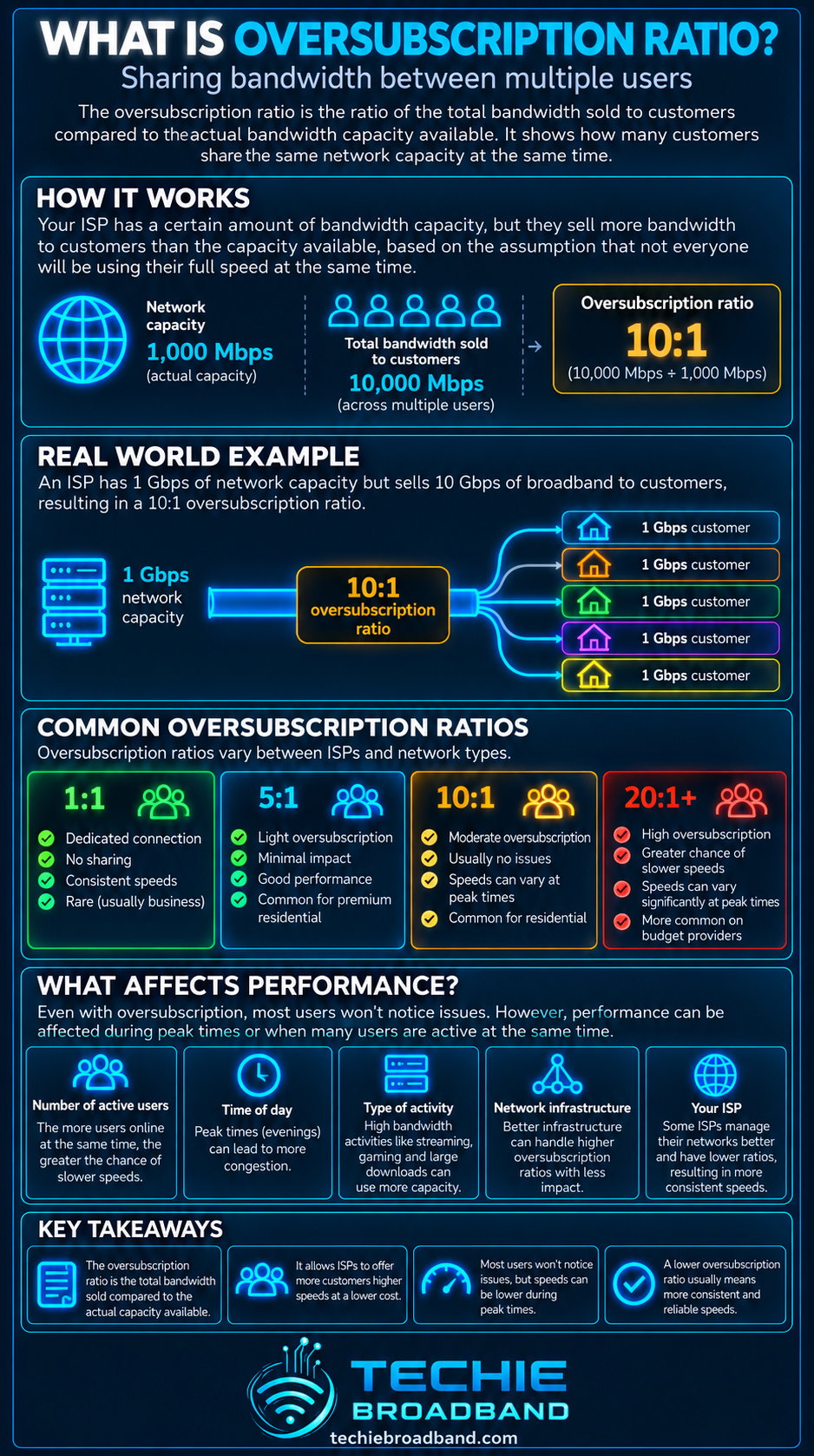
Oversubscription ratio compares the total capacity sold or made available to a group of users with the shared network capacity provisioned to serve them. A 10:1 oversubscription ratio means potential subscribed demand is ten times the shared capacity at that point in the network. It does not mean every customer will receive one tenth of their package speed.
Oversubscription is a capacity planning technique. It works because broadband customers do not normally demand their maximum service rate continuously and simultaneously. The important distinction is that oversubscription creates the possibility of contention, while congestion occurs only when actual demand exceeds available capacity.
What is an oversubscription ratio?
A useful formal definition comes from the Canadian Radio-television and Telecommunications Commission in its 2025 examination of broadband oversubscription. It defines the ratio as combined service capacity subscribed by a group of end users divided by the network capacity provisioned to support those users.
In formula form: oversubscription ratio = total subscribed capacity ÷ shared provisioned capacity.
If 100 customers each subscribe to a 1 Gbps service and a particular shared network stage has 10 Gbps of provisioned capacity, the potential subscribed capacity is 100 Gbps. Dividing 100 Gbps by 10 Gbps gives an oversubscription ratio of 10:1.
That calculation describes a capacity relationship, not what all 100 customers are actually doing at the same instant.
Oversubscription ratio, contention and congestion are not the same thing
Oversubscription is often discussed as though it were synonymous with network congestion. It is not. A network can be oversubscribed and still perform extremely well if simultaneous demand remains below the available shared capacity.
Contention means multiple users or flows may compete for a shared resource. Congestion is the condition that appears when the offered traffic load cannot be carried immediately by the available capacity. Queues can then build, latency can rise and packets may eventually be dropped or marked.
This is why a bare ratio is not enough to predict customer experience. Two networks with the same nominal oversubscription ratio can behave very differently because their subscriber counts, traffic profiles, busy-hour demand, upstream capacity, queue management and upgrade policies differ.
Why broadband networks use oversubscription
Building every shared part of a residential broadband network so every customer could sustain their full retail package rate simultaneously would leave enormous amounts of capacity unused for much of the day. Broadband traffic is statistical. Web browsing, downloads, streaming, gaming, cloud synchronisation and software updates create different traffic patterns at different times.
Cisco's DOCSIS engineering documentation explains that oversubscription planning considers both the peak percentage of simultaneous users and the average data rate per subscriber. Cisco notes that subscribers are not all active at once and do not continuously operate at their peak rate.
Efficient sharing therefore allows network operators to provision less shared capacity than the arithmetic sum of every retail access speed, while adding capacity as real demand grows.
Techie Broadband worked examples
The following examples are theoretical capacity calculations. They do not predict actual customer speeds because real usage is not perfectly simultaneous.
50 customers on 100 Mbps plans sharing 1 Gbps: 5 Gbps subscribed ÷ 1 Gbps = 5:1.
100 customers on 1 Gbps plans sharing 10 Gbps: 100 Gbps ÷ 10 Gbps = 10:1.
500 customers on 500 Mbps plans sharing 25 Gbps: 250 Gbps ÷ 25 Gbps = 10:1.
200 customers on 2.5 Gbps plans sharing 25 Gbps: 500 Gbps ÷ 25 Gbps = 20:1.
Notice that the ratio alone hides scale. A 10:1 design could describe ten customers sharing capacity or thousands of customers aggregated across a much larger platform. The statistical behaviour and resilience of those situations need not be identical.
What happens if everybody uses the connection at once?
A simple equal-share calculation can illustrate the mathematical limit, but it should not be mistaken for a guarantee. In the 100 customer example with 10 Gbps shared capacity, an equal division would be 100 Mbps per customer if all 100 demanded capacity simultaneously and were treated equally.
Real networks do not necessarily divide capacity into equal slices. Flows start and stop, applications use different protocols, traffic management may apply, packet sizes vary and congestion-control algorithms react independently. The useful lesson is simply that the aggregate demand cannot continuously exceed the bottleneck capacity without something giving way.
Where can oversubscription exist in a broadband network?
There is rarely one meaningful oversubscription ratio for an entire end-to-end broadband connection. Capacity can be shared at several different stages.

The access network, where a physical medium or optical capacity is shared.
Aggregation links carrying traffic from access infrastructure deeper into the operator network.
Backhaul between network locations.
ISP core links and switching or routing platforms.
Peering and transit interconnections to other networks.
External services whose own server or network capacity may be the limiting resource.
This end-to-end view connects directly with bandwidth, line rate and sustained throughput. A fast access line does not remove bottlenecks elsewhere in the path.
Oversubscription on FTTP does not mean every user shares one retail speed
On full fibre networks, the exact sharing model depends on the access technology and network design. Passive optical network systems can share optical capacity among multiple premises, while aggregation and backhaul introduce further shared stages. Retail package speeds, optical line rates and provisioned shared capacity are therefore different concepts.
GPON, XGS-PON and point-to-point fibre architectures should not be treated as interchangeable. Nor should the presence of shared infrastructure be taken as evidence that a service is congested. What matters to the customer is whether sufficient capacity exists for actual demand at the relevant time.
Oversubscription ratio versus the old idea of contention ratio
UK broadband users may remember fixed contention ratios such as 20:1 or 50:1 from older broadband marketing. Those numbers can be misleading when treated as a universal description of modern broadband performance.
A UK Government consultation on very hard to reach broadband published in 2023 noted that the broadband Universal Service Obligation used a maximum contention ratio of 50:1 as part of its wider technical specification. The consultation also explained that a lower contention ratio means fewer end users share a network node, reducing the potential for congestion but potentially increasing network cost.
That regulatory example should not be interpreted as saying ordinary modern UK FTTP products all operate at 50:1. Different operators, access networks, products and network stages can be engineered differently, and many providers do not publish a simple customer-facing ratio.
Why a high oversubscription ratio is not automatically bad
Suppose 1,000 customers each have a 1 Gbps package. The arithmetic subscribed capacity is 1 Tbps. If their shared upstream capacity were 100 Gbps, the configured ratio would be 10:1. Yet if busy-hour aggregate demand peaked at only 45 Gbps, the link would still have 55 Gbps of headroom.
In that scenario the network is heavily oversubscribed in terms of sold access rates but not congested by actual traffic. This is the central idea behind statistical multiplexing.
When oversubscription becomes a problem
Oversubscription becomes visible to customers when aggregate demand approaches or exceeds the capacity of a shared bottleneck for meaningful periods. Symptoms can include reduced throughput, higher latency under load, increased jitter, packet loss or ECN marking, and larger queues.
Ofcom's March 2023 home broadband research reported that average 8pm to 10pm download speed across measured connections was 67.7 Mbit/s, 95% of the 71.0 Mbit/s average maximum speed. Ofcom described the peak-time reduction as network congestion or contention. That is measured customer performance, not a published oversubscription ratio.
The distinction matters. A performance test can reveal the outcome of capacity planning. It normally cannot tell you the configured oversubscription ratio inside an ISP.
Oversubscription and peak time performance
If a connection is fast during quiet periods but repeatedly slows during the evening, compare the result with peak time performance. Consistent time-of-day degradation across a clean wired test can indicate a shared capacity issue, although it does not identify which network stage is responsible.
Ofcom tells UK consumers that broadband speed information should include an estimate of the speed likely at busy times, defined as 8pm to 10pm for residential services and 12pm to 2pm for business services. Ofcom's broadband speeds guidance also recommends Ethernet for the most accurate speed testing because WiFi can constrain the result.
Oversubscription and latency
A capacity bottleneck does not only affect download speed. When offered traffic reaches the available rate, packets may wait in queues. This can increase round trip time even before packet loss becomes obvious.
That is why testing Round Trip Time while the connection is idle and again under load can reveal a problem that a single headline speed number misses. Queue behaviour, buffer sizing and active queue management influence the result.
Oversubscription and upload capacity
Downstream and upstream should be considered separately. An asymmetric broadband product can have far less upload speed than download speed, and the shared upstream path may also have a different capacity design.
A saturated upstream can therefore create poor interactive performance even while download capacity remains available. Cloud backups, large uploads, CCTV streams and file synchronisation can expose this quickly.
Can you calculate your ISP's oversubscription ratio from a speed test?
No. A normal customer speed test measures achieved throughput between the test device and a remote endpoint. It does not reveal how many subscribers share each internal network stage, their package rates, the provisioned capacity at each stage or their simultaneous demand.
You can observe symptoms consistent with shared capacity pressure, but you cannot reliably reverse-engineer a specific oversubscription ratio from one speed test.
How to diagnose a suspected shared-capacity problem
Use wired Ethernet to remove WiFi as the first variable.
Confirm the negotiated Ethernet rate and that the router, switch and device interfaces can exceed the broadband package rate.
Pause unrelated traffic on your own network.
Run several throughput tests against capable servers during a quiet period.
Repeat the same tests during the suspected busy period.
Record idle and loaded latency as well as throughput.
Compare download and upload separately.
Repeat across several days so one remote server or transient incident does not dominate the conclusion.
If the pattern is consistently time dependent, ask the ISP whether there is a known capacity issue or planned upgrade.
Do not infer oversubscription merely because one WiFi device is slow. Weak radio signal, interference, a 1 Gbps Ethernet bottleneck, router processing, VPN encryption, storage performance or the remote service can all limit a test.
What is a good oversubscription ratio?
There is no universal good ratio for residential broadband. A ratio cannot be judged sensibly without the number of users, their traffic distribution, service rates, busy-hour demand, capacity growth, resilience targets and the point in the network where the ratio is measured.
For consumers, measured performance at busy times is usually more useful than a standalone engineering ratio. For network operators, the useful question is whether provisioned capacity, traffic forecasts and upgrade thresholds keep actual utilisation within the intended performance envelope.
Oversubscription ratio versus related broadband measurements
Line rate describes the nominal transmission rate of an interface or link.
Bandwidth describes available capacity.
Throughput is the data rate actually achieved over a period.
Goodput is useful application data delivered after protocol overhead and retransmissions.
Latency measures delay.
Oversubscription ratio compares potential subscribed demand with provisioned shared capacity.
Utilisation describes how much of a capacity resource is actually being used.
Congestion occurs when demand cannot be carried immediately by available capacity.
For the application-level distinction, see Goodput. For the difference between short bursts and persistent transfer performance, compare burst speed with sustained throughput.
Frequently asked questions about oversubscription ratio
Does a 10:1 oversubscription ratio mean I only get 10% of my broadband speed?
No. It means potential subscribed capacity is ten times the provisioned shared capacity at the measured point. If other users are not demanding that capacity, an individual customer may still achieve the full capability of their service and path.
Is oversubscription the same as contention?
They are closely related but not identical. Oversubscription describes the configured capacity relationship. Contention describes users or flows competing for shared capacity. Congestion is the performance condition that can result when actual demand exceeds that capacity.
Does FTTP have oversubscription?
FTTP does not automatically mean dedicated end-to-end capacity. Depending on the network architecture, capacity can be shared in the optical access system, aggregation, backhaul, core and interconnection. The details vary by operator, access network, product and location.
Is a 1:1 ratio always better?
A 1:1 design removes that particular oversubscription relationship, but it does not guarantee perfect end-to-end performance. Other interfaces, remote networks, servers, routing, packet loss, latency and local equipment can still limit the connection.
Why do ISPs not publish a contention ratio anymore?
A single ratio can be a poor description of a modern end-to-end broadband service because capacity is shared at multiple stages and traffic demand changes continuously. Consumer performance information such as busy-time speed can be more directly useful, although engineering practices differ between providers.
Can oversubscription cause bufferbloat?
Oversubscription itself is not bufferbloat. If actual traffic saturates a bottleneck, queues can build. Excessively large or poorly managed queues can then create high latency under load, which is the behaviour commonly associated with bufferbloat.
Key takeaway
Oversubscription ratio is a network capacity planning measure, not a direct customer speed measurement. It compares potential subscribed demand with shared provisioned capacity. A higher ratio increases the amount of demand that could compete for a resource, but actual performance depends on simultaneous traffic, capacity, queue management and every other bottleneck along the path.
The number worth watching as a broadband user is therefore not an isolated oversubscription ratio. It is whether the connection continues to deliver strong throughput and responsive latency when the network is busy.
To explore the related technical concepts used in this Oversubscription Ratio guide, visit our broadband terminology guide.
