
What is Packet Fragmentation?
Updated: 3 days ago

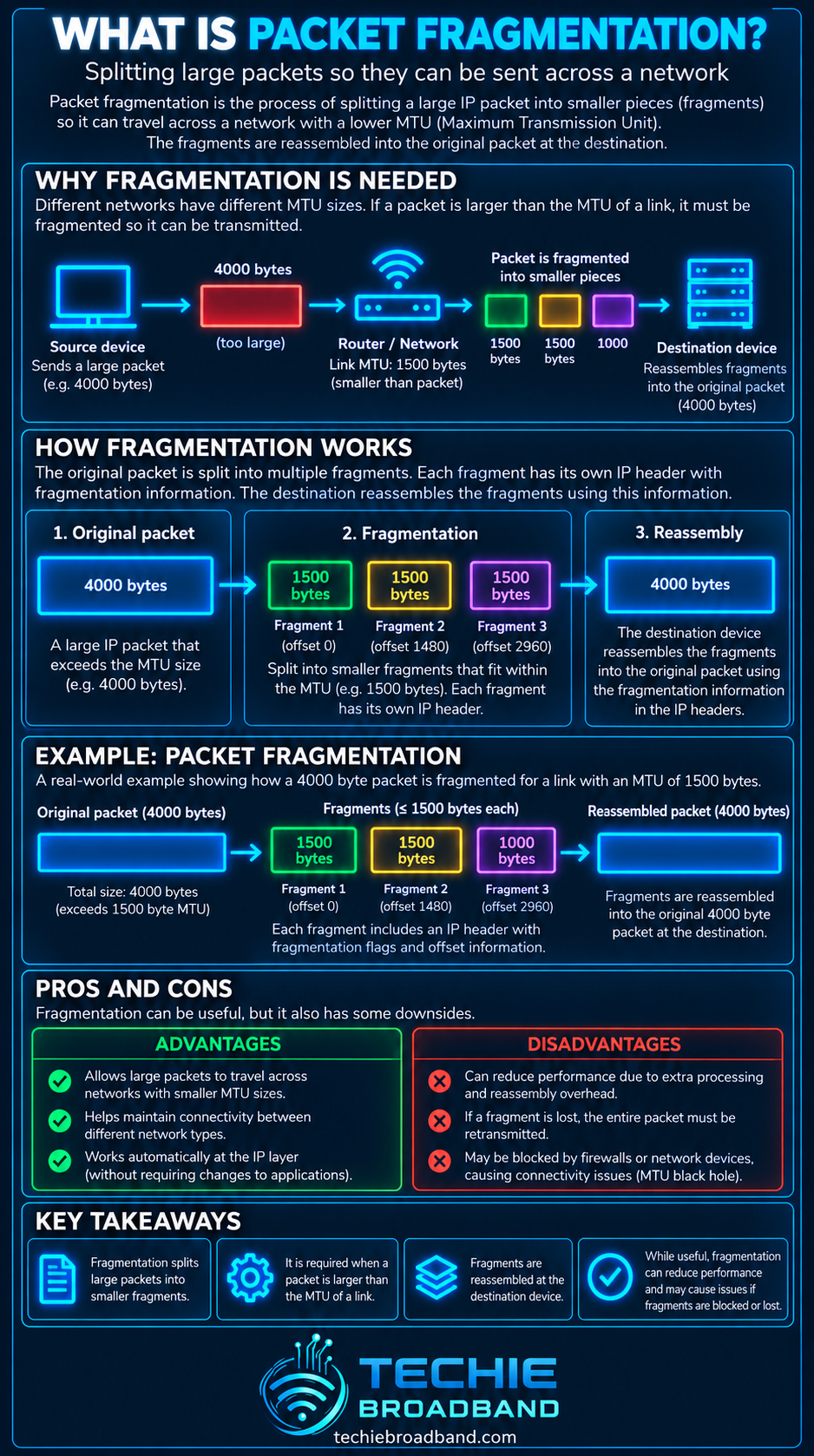
Packet fragmentation is the process of splitting an IP packet into smaller pieces so those pieces can cross a network link whose Maximum Transmission Unit, or MTU, is smaller than the original packet. The fragments travel separately and are reassembled at the destination. The crucial distinction is that IPv4 routers can fragment packets in transit when fragmentation is permitted, while IPv6 routers do not fragment packets in transit. With IPv6, fragmentation is performed only by the source.
Fragmentation matters because it adds headers, processing and failure points. Modern networks generally work better when the sender learns the Path MTU and sizes packets so fragmentation is unnecessary.
What does packet fragmentation mean?
Every network link has a maximum packet size it can carry in one piece. That limit is the MTU. If a packet is larger than a link can forward, the network must either fragment it, reject it and report the size problem, or rely on the sender to avoid creating oversized packets in the first place.
The IETF's original IPv4 specification in RFC 791 defines IPv4 fragmentation and reassembly. The current IPv6 specification in RFC 8200 takes a different approach: routers do not fragment IPv6 packets as they cross the network.
Why do packets need to be fragmented?
A packet can leave a device on a link that supports one MTU and later encounter a smaller MTU elsewhere in the path. Tunnels, encapsulation, PPP links and other network technologies can reduce the amount of space available for the original IP packet.
A device sends a packet that fits its local interface MTU but not a smaller link later in the path.
A VPN or tunnel adds extra headers, reducing the effective MTU available to the original traffic.
An IPv4 packet reaches a router that cannot forward it intact and the packet is allowed to be fragmented.
A sender has not yet learned the correct Path MTU for the destination.
Misconfigured MTU values cause packets to be larger than part of the path can support.
How IPv4 packet fragmentation works
IPv4 includes fields specifically designed to support fragmentation. A router can split an oversized IPv4 datagram into multiple fragments unless the Don't Fragment flag is set. Each fragment becomes its own IPv4 packet with enough information for the destination to reconstruct the original datagram.
Identification: the fragments from the same original IPv4 datagram share an identification value.
Fragment Offset: tells the receiver where the fragment belongs within the original payload. The offset is expressed in units of eight bytes.
More Fragments flag: indicates whether additional fragments follow.
Don't Fragment flag: when set, a router must not fragment the packet. An oversized packet is discarded instead and appropriate ICMP feedback is expected.
Worked IPv4 fragmentation example
Techie Broadband calculation: assume an IPv4 packet has a total length of 4,000 bytes, uses a 20 byte IPv4 header with no options, and encounters a link with a 1,500 byte MTU.
Each fragment needs its own 20 byte IPv4 header. That leaves up to 1,480 bytes of payload in a full size fragment. Because non final fragment payload lengths must align to eight byte units, 1,480 bytes works exactly.
Original packet: 4,000 bytes total, containing 3,980 bytes of payload.
Fragment 1: 20 byte header + 1,480 byte payload = 1,500 bytes. Offset 0.
Fragment 2: 20 byte header + 1,480 byte payload = 1,500 bytes. Offset 185, because 1,480 ÷ 8 = 185.
Fragment 3: 20 byte header + remaining 1,020 byte payload = 1,040 bytes. Offset 370.
Bytes transmitted after fragmentation: 4,040 bytes. The extra 40 bytes come from the two additional IPv4 headers.
This is a theoretical protocol example, not a claim that every 4,000 byte packet will be fragmented in this exact way. Options, encapsulation, implementation behaviour and the actual path can change the result.
How IPv6 fragmentation is different
IPv6 deliberately removes in transit router fragmentation. Under RFC 8200, if a router cannot forward an IPv6 packet because it is larger than the next link MTU, the router discards it and sends an ICMPv6 Packet Too Big message back to the source. The source can then reduce packet size.
If IPv6 fragmentation is genuinely required, the source creates the fragments using the IPv6 Fragment extension header. Routers along the path do not create those fragments.
IPv6 requires every link to support an MTU of at least 1,280 bytes at the IPv6 layer, with any lower layer link handling its own fragmentation and reassembly below IPv6. RFC 8200 strongly recommends Path MTU Discovery so senders can take advantage of paths that support larger packets.
IPv4 versus IPv6 fragmentation
IPv4 routers: may fragment packets in transit when fragmentation is permitted.
IPv4 with Don't Fragment set: an oversized packet is dropped rather than fragmented.
IPv6 routers: never fragment packets in transit.
IPv6 source: may use the Fragment header when source fragmentation is required.
Both protocols: generally benefit from discovering the Path MTU and avoiding unnecessary fragmentation.
Packet fragmentation and Path MTU Discovery
Path MTU Discovery, or PMTUD, attempts to learn the smallest MTU across the path between source and destination. For IPv4, RFC 1191 describes the classic process using the Don't Fragment bit and ICMP feedback. For IPv6, RFC 8201 defines Path MTU Discovery using ICMPv6 Packet Too Big messages.
The goal is not to fragment efficiently. The better goal is usually to avoid fragmentation by making the packet small enough to traverse the complete path intact.
If the required ICMP feedback is filtered or never reaches the sender, Path MTU Discovery can fail. This can create an MTU black hole, where smaller traffic works but larger packets disappear and connections may stall.
Why packet fragmentation can reduce network efficiency
Header overhead increases because each fragment carries an IP header.
A lost fragment can prevent successful reassembly of the complete original packet.
Fragmentation and reassembly require additional processing and state.
Fragments may interact poorly with firewalls, NAT devices, tunnels and other middleboxes.
Packet loss can become more disruptive because one missing piece affects the complete reassembled datagram.
Troubleshooting becomes harder because a single logical packet is represented by several IP packets on the wire.
Fragmentation is therefore related to, but not the same as, packet loss. Fragmentation creates multiple packets from one original datagram. Packet loss describes packets or fragments failing to reach their destination.
Does fragmentation make broadband slower?
Fragmentation does not directly reduce the physical line rate of a broadband connection. It can, however, reduce efficiency and application performance because more bytes may be transmitted, more packets must be processed, and lost fragments can trigger retransmission or application level recovery.
That distinction matters. Bandwidth describes network capacity, while throughput is the actual data rate achieved. Fragmentation can contribute to the gap between theoretical capacity and useful performance without changing the underlying broadband line rate.

Packet fragmentation on UK broadband connections
On a typical UK home broadband connection, fragmentation is not determined simply by whether the access network is FTTP, FTTC, cable or another technology. The effective packet size depends on the complete path, including the customer's device, router, WAN encapsulation, ISP network, tunnels, remote network and destination.
Ethernet commonly uses a 1,500 byte MTU, but that does not mean every internet path supports a 1,500 byte IP packet end to end. PPPoE and tunnel overhead are common reasons for lower effective MTUs. The exact value depends on the ISP, access network, product, router configuration and any additional encapsulation.
As UK users adopt multi gig broadband, avoiding unnecessary packet processing can matter more because the bottleneck may move from the access line to routers, firewalls, VPN gateways, network adapters or other equipment.
Fragmentation, VPNs and tunnels
VPNs and tunnels wrap the original traffic inside additional protocol headers. Those headers consume part of the available packet size. If the outer path has a 1,500 byte MTU, the inner packet often needs to be smaller than 1,500 bytes once tunnel overhead is included.
This is why a VPN can work for small requests yet struggle with larger transfers when MTU handling is wrong. Correct tunnel MTU, TCP MSS handling and functioning PMTU feedback are more robust than simply choosing an arbitrary low MTU.
Packet fragmentation and TCP MSS
MTU and TCP Maximum Segment Size, or MSS, are related but different. MTU limits the size of the IP packet carried by a link. TCP MSS is the maximum TCP payload size an endpoint advertises for a TCP segment.
On a conventional 1,500 byte IPv4 Ethernet path with a 20 byte IPv4 header and 20 byte TCP header, an MSS of 1,460 bytes is common. With IPv6 and a basic 40 byte IPv6 header plus 20 byte TCP header, 1,440 bytes is the corresponding simple calculation. Options and extension headers can change the available payload.
MSS clamping can be used at some routers and tunnel endpoints to reduce TCP segment sizes and avoid fragmentation or PMTU problems. It does not solve every MTU problem because not all traffic uses TCP.
How to diagnose packet fragmentation problems
Reproduce the problem consistently. Establish whether the issue is general slowness, packet loss or a repeatable size dependent failure.
Test using wired Ethernet where practical so WiFi variability is not confused with an MTU issue.
Temporarily remove VPNs or tunnels and compare behaviour.
Check interface, WAN, tunnel and VPN MTU settings. Do not lower values blindly.
Use packet size tests appropriate to the operating system and protocol. Remember that ping behaviour does not reproduce every TCP, UDP or tunnel condition.
Inspect packet captures for IPv4 fragments, IPv6 Fragment headers, ICMP Fragmentation Needed messages, ICMPv6 Packet Too Big messages and repeated retransmissions.
Check whether firewalls or security devices are blocking ICMP or ICMPv6 feedback required by PMTU Discovery.
Compare multiple destinations. Different internet paths can have different Path MTUs.
If larger packets disappear while smaller packets work, investigate MTU black hole behaviour rather than assuming the broadband line itself is faulty.
Common packet fragmentation misconceptions
Fragmentation always means something is broken
No. Fragmentation is a defined part of IP behaviour. The concern is unnecessary or unexpected fragmentation, excessive overhead, or a failure to deliver and reassemble fragments correctly.
A 1500 byte Ethernet MTU means every internet path supports 1500 byte IP packets
No. The Path MTU is determined by the smallest relevant MTU across the complete route, not simply the local Ethernet interface.
IPv6 cannot be fragmented
Incorrect. IPv6 routers cannot fragment packets in transit, but an IPv6 source can create fragments using the Fragment extension header.
Lowering MTU is always the correct fix
No. Lowering MTU can avoid a particular failure, but it can also hide the real problem. The correct value should reflect the actual network path and encapsulation requirements.
Packet fragmentation FAQs
What is packet fragmentation in simple terms?
Packet fragmentation is when one IP packet is divided into smaller fragments so the data can cross a network link with a smaller MTU. The destination reassembles the pieces.
Who fragments IPv4 packets?
The sending host can create fragmented IPv4 traffic, and an IPv4 router may fragment an oversized packet in transit when fragmentation is permitted.
Who fragments IPv6 packets?
Only the IPv6 source creates IPv6 fragments. Routers do not fragment IPv6 packets as they forward them.
What happens if an IPv4 packet has the Don't Fragment flag set?
If a router cannot forward the packet because the next link MTU is too small, it drops the packet rather than fragmenting it and should return the relevant ICMP feedback.
What happens if an IPv6 packet is too large?
The router drops the oversized packet and sends an ICMPv6 Packet Too Big message to the source. The source can then reduce its packet size.
Is fragmentation the same as packet loss?
No. Fragmentation splits a packet into smaller pieces. Packet loss occurs when a packet or fragment fails to reach its destination.
Can VPNs cause fragmentation?
VPNs can make fragmentation or PMTU problems more likely because tunnel headers reduce the space available to the original packet.
Should I disable fragmentation?
There is no universal setting that should simply be disabled. The preferred approach is usually correct MTU configuration and functioning Path MTU Discovery so packets are appropriately sized.
Key takeaway
Packet fragmentation is a mechanism for dealing with packets that are too large for part of a network path. IPv4 can allow routers to fragment packets in transit, while IPv6 moves that responsibility to the source. In both cases, the more efficient outcome is normally to understand the Path MTU and send packets that can traverse the path without fragmentation.
To explore the related technical concepts used in this Packet Fragmentation guide, visit our broadband terminology guide.
