
What is Throttling?
Updated: 3 days ago

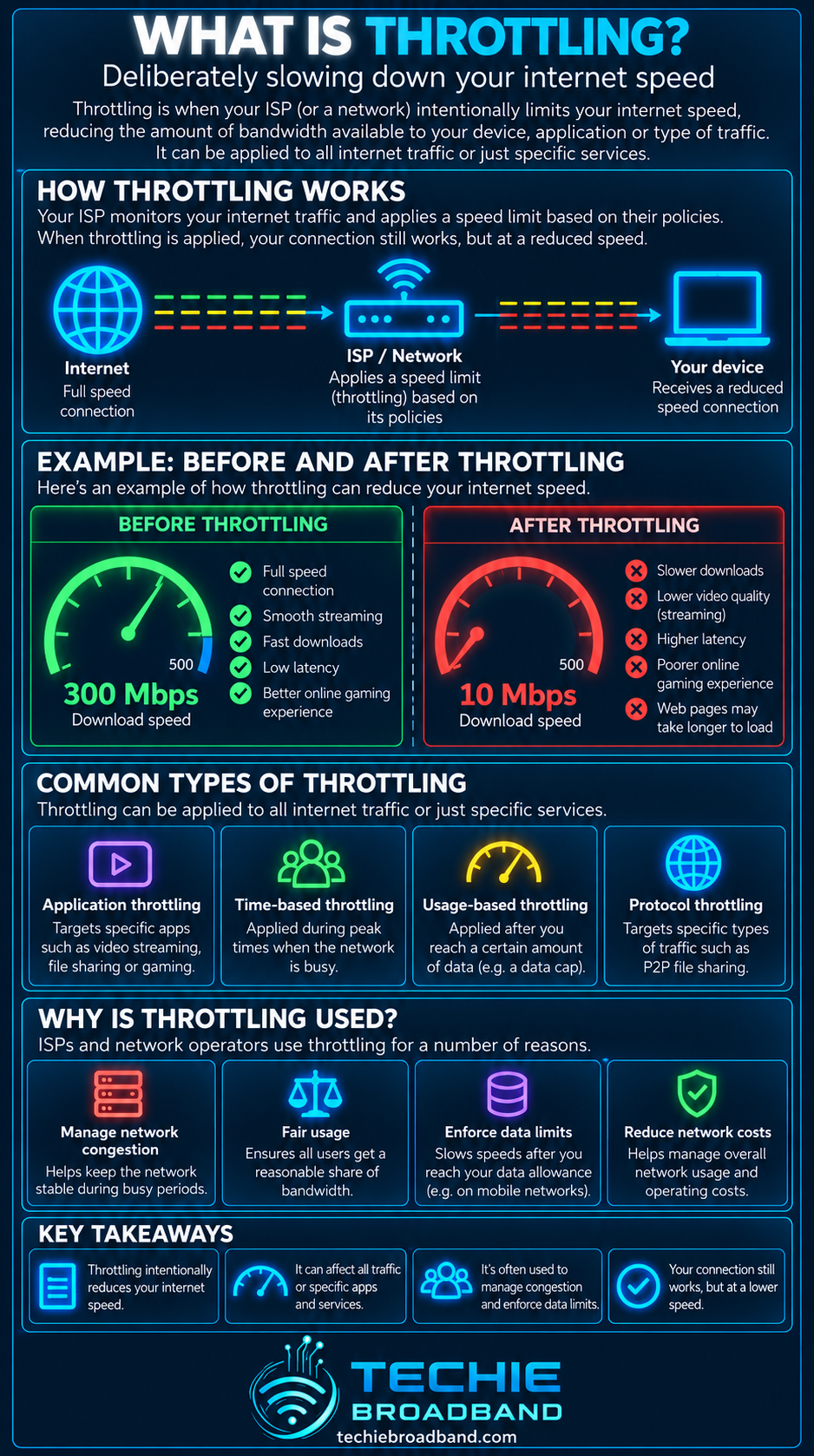
Throttling is the deliberate restriction of the data rate available to a connection, subscriber, application, traffic class or flow. In broadband terms, it means a policy is intentionally preventing traffic from using all the capacity it might otherwise be able to reach. The crucial distinction is intent: a slow connection is not automatically being throttled.
Throttling is also not a precise synonym for traffic shaping. Shaping is one technical mechanism that can enforce a rate by queueing excess traffic. A throttle is the broader policy outcome and can be implemented with shaping, policing, subscriber controls, application controls or other rate limiting mechanisms.
How does throttling work?
A network first identifies the traffic to which a policy applies. That classification might be as broad as an entire subscriber connection or as narrow as a particular traffic class. A rate control mechanism then enforces the permitted profile. Depending on the implementation, excess packets may be delayed, dropped, remarked or simply prevented from being scheduled above the configured rate.
The IETF's Differentiated Services architecture describes traffic conditioning functions that can include metering, policing, shaping and packet marking. Cisco's current QoS documentation likewise distinguishes shaping, which buffers excess traffic, from policing, which can immediately drop or remark traffic outside a configured profile.
Throttling, traffic shaping and policing are different
Throttling describes the deliberate rate restriction or policy outcome.
Traffic shaping normally buffers excess packets and schedules them later, creating a smoother output rate.
Traffic policing applies an immediate action to traffic outside the permitted profile, commonly dropping or remarking packets.
Traffic management is broader still and can include classification, prioritisation, scheduling, shaping, policing and queue management.
Cisco's 2026 comparison of traffic shaping and policing explains that both can enforce a maximum rate, but shaping uses a queue whereas policing does not buffer excess traffic in the same way.
Throttling versus congestion
Congestion occurs when traffic demand competes for insufficient capacity at a bottleneck. Throttling is a deliberate policy. The two can produce similar symptoms, including reduced throughput, increased transfer times and application slowdown, but the causes are different.
A repeatable ceiling can be evidence of rate control, especially if it remains stable across capable devices, test servers and times of day. It is not proof. WiFi limits, Ethernet negotiation, router processing, remote server capacity and access network bottlenecks can all produce ceilings that look similar.
Where can throttling happen on a broadband path?
A rate limit can be introduced at several points in the end to end path. That is why diagnosis needs to isolate the bottleneck rather than jump straight to the ISP.

On the customer router or firewall through local QoS or rate limits.
Within an ISP subscriber policy or service profile.
At an access or aggregation layer where a product profile is enforced.
At an interconnection or service edge where a particular traffic class is controlled.
Inside an application, CDN or remote service that applies its own delivery limits.
Techie Broadband calculation: what a 90% throttle does
Consider an idealised 1 Gbit/s connection deliberately limited to 100 Mbit/s. The configured ceiling is one tenth of the original rate.
Rate reduction = (1,000 − 100) ÷ 1,000 × 100 = 90%
For a 10 GB decimal file, 10 GB equals 80 Gbit. Ignoring protocol overheads and every other bottleneck, 80 Gbit ÷ 1 Gbit/s = 80 seconds. At 100 Mbit/s, the same transfer takes 800 seconds, or 13 minutes 20 seconds. This is a theoretical calculation, not a prediction of real world download time.
What can trigger throttling?
There is no single universal broadband throttling policy. A provider, network operator, enterprise or application can define different rules. Where throttling exists, possible triggers can include a subscriber product profile, a contractual service rate, traffic class policy, usage policy, network protection mechanism or application specific control.
Do not assume that ordinary evening slowdown proves deliberate throttling. Peak demand can reduce available capacity through contention or congestion without a policy deliberately targeting a subscriber or application.
Can an ISP throttle only certain traffic?
Technically, rate control can be applied after traffic has been classified, so different classes can receive different treatment. Whether a particular UK provider actually does this is a separate factual question that must be established from that provider's current policy and evidence. The existence of QoS capability does not prove discriminatory throttling.
Does throttling increase latency?
It can, depending on the mechanism. A shaper may add queueing delay because packets wait before transmission. That can increase latency and, if queues become excessive, contribute to bufferbloat. A policer that drops excess traffic can instead increase retransmission and reduce TCP performance. A simple application rate cap may behave differently again.
How throttling affects packet loss, jitter and goodput
The outcome depends on implementation. Queue overflow or policing can contribute to packet loss. Variable queueing can affect jitter. TCP retransmissions and protocol overhead mean the useful application data rate, or goodput, can be lower than the nominal rate limit.
Throttling and burst speed
A rate policy does not always produce a perfectly flat line. Token bucket based mechanisms can permit controlled bursts. A connection can therefore show a brief burst speed above its longer term permitted rate before settling to a lower sustained throughput. Test duration matters.
How to test whether your broadband may be throttled
Use a capable device connected by wired Ethernet so WiFi is not the first unknown.
Confirm the Ethernet link has negotiated at the expected line or interface rate.
Pause cloud backups, downloads, uploads and other competing traffic.
Run repeated throughput tests to several suitable servers.
Compare short tests with longer sustained transfers.
Test download and upload separately.
Repeat the same tests at different times, including peak and quieter periods.
Measure idle latency and latency under load.
Check whether the ceiling follows one device, router, destination or the broadband connection itself.
Compare the evidence with your ISP product specification and current traffic management or acceptable use information before concluding deliberate throttling.
Also compare the observed result with line rate, peak time performance and queue depth. A bottleneck elsewhere can mimic a policy limit.
Why VPN tests do not automatically prove throttling
A VPN changes more than traffic visibility. It can change routing, peering, destination, encryption overhead, packet size behaviour and the servers used in the path. If performance changes through a VPN, that is useful diagnostic evidence, but it does not by itself prove that an ISP was throttling the original traffic.
Can throttling be beneficial?
Rate control is not inherently bad. Networks deliberately constrain rates for legitimate engineering reasons, including matching a faster interface to a slower downstream path, enforcing a purchased service profile, protecting a bottleneck, controlling bursts or creating predictable QoS behaviour. The important questions are what is being limited, why, to what rate and with what effect on users.
Throttling on UK broadband
UK broadband performance depends on the combination of ISP, access network, product and location. FTTP, cable, fixed wireless and mobile services can have very different service profiles and bottlenecks. A retail package's advertised rate, the physical access technology and any operational rate control should not be treated as interchangeable.
For example, a speed below an advertised maximum may be caused by the access link, local network, congestion or remote service rather than deliberate throttling. Start with bandwidth and end to end bottlenecks before attributing intent.
Common throttling misconceptions
Any slow speed means the ISP is throttling you. False: many non-policy bottlenecks produce the same symptom.
Traffic shaping and throttling are identical. Not necessarily: shaping is one implementation mechanism.
A VPN proving faster means throttling is confirmed. No: the VPN also changes the network path and other variables.
A 1 Gbit/s package guarantees every transfer can run at 1 Gbit/s. No: end to end performance depends on every relevant bottleneck.
Throttling always causes packet loss. No: a shaper may queue traffic instead, while a policer may drop or remark it.
Frequently asked questions
What is broadband throttling in simple terms?
Broadband throttling is a deliberate policy that restricts the data rate available to some traffic or to a connection. It is different from an accidental bottleneck or ordinary congestion.
Is throttling the same as traffic shaping?
No. Traffic shaping is a specific rate control mechanism that normally queues excess packets and sends them later. Throttling is the broader description of deliberately restricting a rate.
How can I tell if my ISP is throttling me?
Look for repeatable, controlled evidence after excluding WiFi, Ethernet, router, device, server and congestion limits. A stable ceiling can justify further investigation, but one speed test is not proof.
Can a VPN bypass throttling?
Sometimes a VPN changes the conditions that caused a rate difference, but a faster VPN result does not prove throttling because the VPN also changes routing, endpoints and protocol overhead.
Does throttling affect gaming?
A pure throughput cap may have little effect on a low bandwidth game if sufficient capacity remains, but queueing, packet loss or contention associated with the rate control can affect latency and responsiveness.
Is throttling illegal in the UK?
Whether a specific practice is permitted depends on the service, contract, transparency requirements and applicable regulation. This article explains the networking behaviour rather than making a legal determination about a particular provider.
Key takeaway
Throttling means deliberate rate restriction. The technical mechanism may be shaping, policing or another policy control. The most useful diagnostic rule is not to infer intent from a low speed alone: first establish where the bottleneck is, whether the ceiling is repeatable and whether other technical explanations have been eliminated.
To explore the related technical concepts used in this Throttling guide, visit our broadband terminology guide.
