
What is Traffic Shaping?
Updated: 3 days ago

Traffic shaping is a network Quality of Service (QoS) technique that controls the rate at which traffic leaves a network interface. Instead of immediately discarding traffic that exceeds a configured rate, a shaper normally places excess packets in a queue and transmits them later. The result is a smoother output rate, but the trade off is queueing delay and, if the queue fills, possible packet loss.
The most important distinction is that traffic shaping does not create bandwidth. It deliberately controls when packets are transmitted. This can make a bursty flow fit a slower downstream link, enforce a service rate, or manage contention more predictably.
How does traffic shaping work?
A traffic shaper measures offered traffic against a configured rate. Packets that can be sent within that profile are transmitted. Packets that arrive faster than the allowed rate can be buffered and scheduled for later transmission. The IETF's RFC 7640 traffic management framework describes traffic shaping as actively buffering and smoothing the output rate to adapt bursty traffic to configured limits.
A common implementation uses a token bucket model. Tokens represent permission to transmit a quantity of data. Tokens accumulate at a configured rate up to a defined bucket capacity. A packet can be sent when enough tokens are available; otherwise a shaper can hold it until transmission becomes eligible.
Configured rate: the long term rate the shaper attempts to enforce.
Burst allowance: token bucket parameters can allow controlled short bursts rather than producing a perfectly flat stream.
Queue: stores packets that are waiting for transmission eligibility.
Scheduler: determines which eligible queued packet is sent next when multiple classes or flows exist.
Traffic shaping versus traffic policing
Traffic shaping and traffic policing can both enforce a maximum rate, but they react differently when traffic exceeds that rate. Cisco's current comparison of policing and shaping explains that shaping retains excess packets in a queue and schedules them later, while policing normally drops or remarks traffic that exceeds the configured profile.
Traffic shaping: delays excess packets and smooths the output rate.
Traffic policing: takes an immediate action on traffic outside the permitted profile, commonly dropping or remarking it.
Shaping needs queue memory because packets may wait.
Policing does not need to buffer excess packets in the same way.
A network can use both mechanisms at different points or even as parts of the same QoS design.
This distinction matters for broadband. A hard rate limit implemented by policing can create packet loss when bursts exceed the permitted profile. A shaper can absorb a burst, but the queue that absorbs it adds latency.
Traffic shaping is not the same as throttling
In everyday broadband discussion, traffic shaping and throttling are often used as if they mean the same thing. Technically, they are not necessarily identical.
Traffic shaping is a specific rate control mechanism. Throttling is a broader descriptive term for deliberately reducing or restricting a data rate. A throttling policy might be implemented with shaping, policing, application controls, subscriber policy or another mechanism. Seeing a lower speed therefore does not prove that a shaper is responsible.
Traffic shaping is not the same as traffic management
Traffic management is the wider category. It can include classification, marking, queueing, scheduling, prioritisation, policing, shaping and Active Queue Management. Traffic shaping is one tool within that wider system.
What does a traffic shaper actually change?
The timing of packet transmission.
The maximum or average output rate seen over a measurement interval.
How bursts are absorbed and released.
Queue depth and therefore queueing delay.
How different traffic classes share a constrained link when shaping is combined with scheduling.
The pattern of packet loss when the shaping queue reaches its limit.
It does not increase the physical line rate, guarantee lower latency, or automatically improve application performance. A poorly sized shaping queue can make latency worse even while the output rate looks smooth.
A traffic shaping network path
The diagram below shows the basic data path. Bursty traffic enters the shaper, packets wait when the offered rate exceeds the configured output rate, and the scheduler releases them at a controlled rate.

Techie Broadband calculation: what queueing can do to delay
The simplest way to understand shaping delay is to convert queued data into transmission time.
Assume an idealised shaper is configured to 100 Mbit/s and 250 Mbit of data is already waiting in front of a newly arrived packet. Ignoring packet scheduling detail and other network delay:
250 Mbit ÷ 100 Mbit/s = 2.5 seconds
That 250 Mbit backlog represents 2.5 seconds of serialisation time at the shaped rate. This is deliberately an extreme teaching example, but it shows why queue size and shaping rate cannot be considered separately.
A 1 Gbit burst through a 100 Mbit/s shaper
If 1 Gbit of data had to pass through an ideal 100 Mbit/s shaper, the theoretical drain time would be:
1,000 Mbit ÷ 100 Mbit/s = 10 seconds
Real traffic is more complicated because packets arrive while the queue is draining, protocols add overhead, scheduling may divide capacity between classes and the configured shaper may permit bursts. The calculation is a theoretical reference, not a prediction of an application transfer time.
Traffic shaping and latency
Traffic shaping can increase latency because queued packets wait before transmission. This is queueing delay. If a shaper is configured below the true bottleneck rate and paired with effective queue management, however, it can move the queue from an uncontrolled downstream bottleneck into a device that can manage it more intelligently.
That is why shaping sometimes appears in attempts to control bufferbloat. The improvement does not come from shaping magically making packets faster. It comes from controlling where congestion forms and how the queue behaves.
Traffic shaping and queue depth
A shaper requires somewhere to hold deferred packets. Queue depth therefore becomes part of the design. A very shallow queue may drop packets during bursts. A very deep unmanaged queue may absorb more traffic but create large delays.
The right answer is not simply 'use a bigger buffer'. The required queue behaviour depends on the link rate, traffic mix, burst characteristics, latency objectives and the queue management algorithm.
Traffic shaping and packet loss
Shaping can reduce loss caused by an immediate rate mismatch because excess traffic can wait rather than being discarded at once. It cannot eliminate packet loss. If arrivals continue to exceed the shaped service rate for long enough, the queue can eventually fill and packets may be dropped.
Traffic shaping and jitter
Because shaping changes when packets are transmitted, it can influence jitter. A stable scheduler can make an output stream more predictable, while changing queue occupancy can also create variable delay. Real time traffic such as voice and gaming is particularly sensitive to delay variation.
Traffic shaping and throughput
A shaper can intentionally cap throughput below the physical line rate. If a 1 Gbit/s Ethernet interface has a 500 Mbit/s shaper applied to a traffic class, the interface can still physically operate at 1 Gbit/s while that class is deliberately constrained to the configured policy.
This is why an interface speed, broadband sync or optical line rate does not by itself tell you the rate a particular traffic class will receive.
Traffic shaping and microbursts
Short microbursts can momentarily exceed the service rate even when average utilisation looks modest. A shaper can absorb some bursts if the queue and token bucket parameters allow it, then release the traffic over time.
That smoothing is useful when a fast upstream interface feeds a slower downstream link. Without suitable control, the slower point can become the place where an uncontrolled queue or packet loss develops.
Traffic shaping and network congestion
Traffic shaping is often used around a known bottleneck, but it should not be confused with network congestion itself. Congestion occurs when traffic demand exceeds the capacity available at a point in the path. Shaping deliberately constrains a rate and can therefore create a managed queue by design.
Why shape below the real bottleneck?
A common home networking use case is to configure a router slightly below the sustainable WAN rate so that the router, rather than a less controllable modem, access link or provider queue, becomes the dominant bottleneck.
For example, if a connection reliably sustains 100 Mbit/s upstream, a user might test a shaper below that figure rather than setting it exactly to 100 Mbit/s. The appropriate margin is connection and implementation specific. It should be measured rather than copied from a generic percentage.
Traffic shaping, SQM and Active Queue Management
Smart Queue Management (SQM) is a broader practical approach commonly combining rate control with modern queue management and scheduling. Traffic shaping controls the offered rate. Active Queue Management monitors queues and can deliberately signal congestion or drop packets before a queue simply fills.
RFC 7640 treats shaping, queueing and Active Queue Management as distinct traffic management functions. They can work together, but the terms should not be collapsed into one another.
Can traffic shaping prioritise gaming or voice?
Shaping by itself controls a rate. Prioritisation requires classification and scheduling policy. A QoS system can classify voice, gaming, bulk transfers or other traffic into different queues, then schedule those queues while a parent shaper controls the total output rate.
That can protect latency sensitive traffic from bulk transfers, but only if classification is accurate and the actual bottleneck is under the device's control. Encrypted traffic and changing application behaviour can make application classification difficult.
Can an ISP use traffic shaping?
Yes. ISPs and network operators can use shaping and other QoS mechanisms inside their networks, at subscriber service boundaries, at interconnects or around specific capacity constraints. However, a customer seeing a speed below the package headline cannot conclude that the ISP is deliberately shaping their traffic.
The same symptom can be caused by WiFi, an Ethernet negotiation issue, access network limits, congestion, server capacity, TCP behaviour, a device bottleneck, VPN processing, packet loss or many other factors.
UK broadband and traffic management
For UK broadband, the practical effect depends on the complete service chain: ISP, access network, product and location. FTTP, FTTC, cable, fixed wireless and mobile networks have different capacity and scheduling characteristics. Retail products can also have different upload and download profiles even when they use the same underlying access network.
Traffic shaping should therefore be discussed as a mechanism, not assumed to be present on every UK broadband service or attributed to a provider without evidence.
Does traffic shaping explain slower speeds at peak time?
Not necessarily. Peak time performance can fall because shared capacity is busier. That is different from proving a configured shaper is limiting a subscriber or traffic class.
A repeatable ceiling at the same rate can be consistent with a configured rate limit, but it is not proof. The diagnostic task is to identify where that ceiling is being introduced.
Traffic shaping and burst speed
Token bucket behaviour can allow traffic to burst above a long term configured rate for a limited period. This can contribute to a burst speed that is higher than the sustained throughput observed over a longer test.
The exact behaviour depends on the implementation, bucket parameters and measurement window. Do not assume every short speed spike is evidence of token bucket shaping.
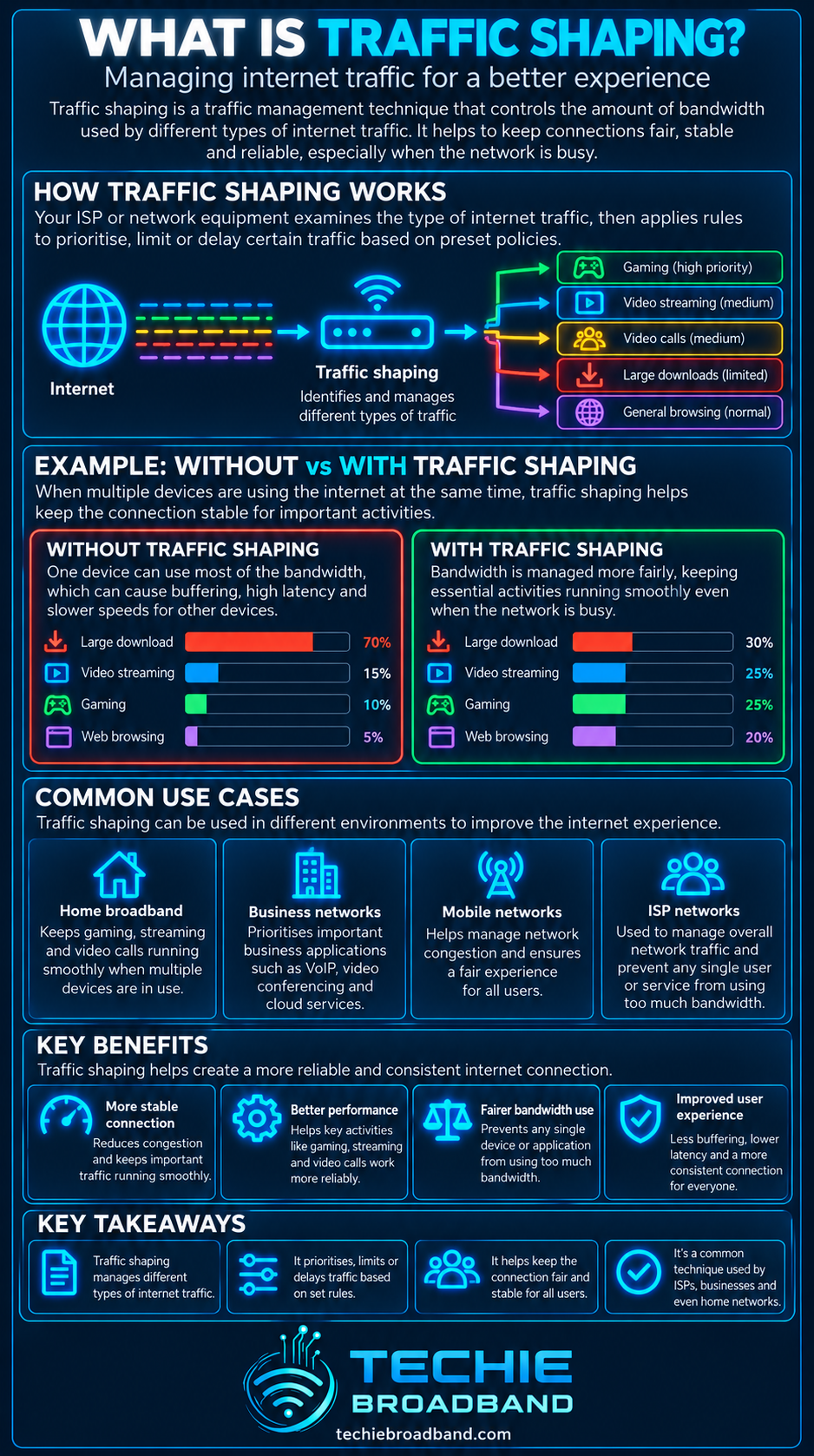
Traffic shaping reference infographic
This Techie Broadband reference summarises the key distinction between shaping and policing and shows why queueing delay is central to understanding the mechanism.
How to test whether a rate limit may be affecting your broadband
Connect one capable device by wired Ethernet and remove WiFi from the test path.
Confirm the Ethernet link has negotiated at the expected interface rate.
Pause cloud backups, uploads, downloads and other competing traffic.
Run repeated throughput tests to multiple appropriate test servers.
Compare short tests with longer sustained transfers.
Test at different times of day.
Measure idle latency and latency while download and upload traffic are active.
Compare upload and download behaviour separately.
Check whether the observed ceiling follows one device, one router, one destination or the broadband connection itself.
If possible, compare with a different router or a direct supported test arrangement before attributing the limit to the ISP.
A consistent plateau can indicate a configured service rate, but diagnosis should separate deliberate shaping from product provisioning, interface limits, access technology, congestion and remote server limits.
How to recognise a local router shaper
If you have configured QoS, SQM, bandwidth control, parental controls or per device rate limits on your own router, disable or inspect those policies before investigating the ISP. Some routers retain old bandwidth values after a package upgrade, which can leave a faster broadband service capped by local configuration.
Common traffic shaping misconceptions
Traffic shaping always means an ISP is slowing me down. False. Shaping is a general QoS mechanism used in many networks, including customer routers.
Shaping and policing are the same. False. Shaping normally queues excess traffic; policing takes an immediate action such as dropping or remarking it.
A shaper makes a connection faster. False. It controls transmission rate and can deliberately lower throughput.
Shaping always lowers latency. False. Queued packets incur delay. Good queue management can improve loaded responsiveness in some designs.
A flat speed test proves shaping. False. Many different bottlenecks can produce a stable ceiling.
Traffic shaping is the same as prioritisation. False. Rate control and scheduling priority are separate functions, although they are often combined.
Traffic shaping FAQs
What is traffic shaping in simple terms?
Traffic shaping deliberately controls when packets leave a network interface. Traffic above the configured rate can wait in a queue and be sent later, producing a smoother output rate.
Does traffic shaping reduce internet speed?
It can. If the configured shaping rate is below the capacity the connection could otherwise deliver, measured throughput will be capped by that policy.
Is traffic shaping bad?
Not inherently. It is a network engineering tool. Correctly designed shaping can make a bottleneck predictable and help queue management. Poor configuration can unnecessarily limit throughput or create excessive delay.
Is traffic shaping the same as QoS?
No. QoS is broader. Shaping is one mechanism that can sit alongside classification, marking, scheduling, prioritisation, policing and queue management.
Can traffic shaping cause high ping?
Yes. If packets wait in a shaping queue, ping RTT can increase. Queue size, offered load, scheduling and queue management determine how large that increase becomes.
Can traffic shaping stop bufferbloat?
Shaping can help place the bottleneck where a router can manage it, but shaping alone is not a complete bufferbloat solution. Queue management and scheduling behaviour matter.
Can traffic shaping affect only uploads?
Yes. A policy can be applied to a particular direction, interface or traffic class depending on the platform. Home routers commonly have separate download and upload controls.
How is traffic shaping different from bandwidth limiting?
Bandwidth limiting describes the outcome of restricting a rate. Traffic shaping is one technical way to implement that restriction by buffering and scheduling excess packets.
The key point
Traffic shaping is controlled queueing for rate enforcement. It smooths traffic by delaying packets that exceed a configured transmission profile instead of necessarily discarding them immediately. That makes it useful for matching rates and controlling bottlenecks, but it also means shaping must be understood together with queue depth, latency, scheduling and packet loss.
For broadband troubleshooting, do not jump from 'my speed is lower than expected' to 'my ISP is traffic shaping me'. First identify the actual bottleneck, test the complete path and distinguish shaping from policing, congestion, provisioning and local network limits.
To explore the related technical concepts used in this Traffic Shaping guide, visit our broadband terminology guide.
