
What is Asymmetric Routing?
Updated: 3 days ago

Asymmetric routing is when traffic travelling between two endpoints takes a different network path in one direction than it does on the return journey. The outbound and return routes do not have to pass through the same routers, networks, peering points or transit providers.
It is a normal property of the internet rather than automatically a fault. It matters because routing decisions are made independently by different networks, and because tools such as traceroute usually reveal only the path taken by their own probes. A different return path can therefore affect how latency, packet loss and routing problems should be interpreted.
What does asymmetric routing mean?
In a perfectly symmetric path, packets from A to B and replies from B to A traverse the same sequence of routing devices in reverse order. Asymmetric routing breaks that assumption. The two directions still belong to the same communication, but the internet can select different paths for each direction.
For example, traffic from a UK broadband connection might leave the ISP through a London peering point, while the reply reaches that ISP through a different interconnection or upstream network. Both paths can be valid and healthy.
A simple asymmetric routing example
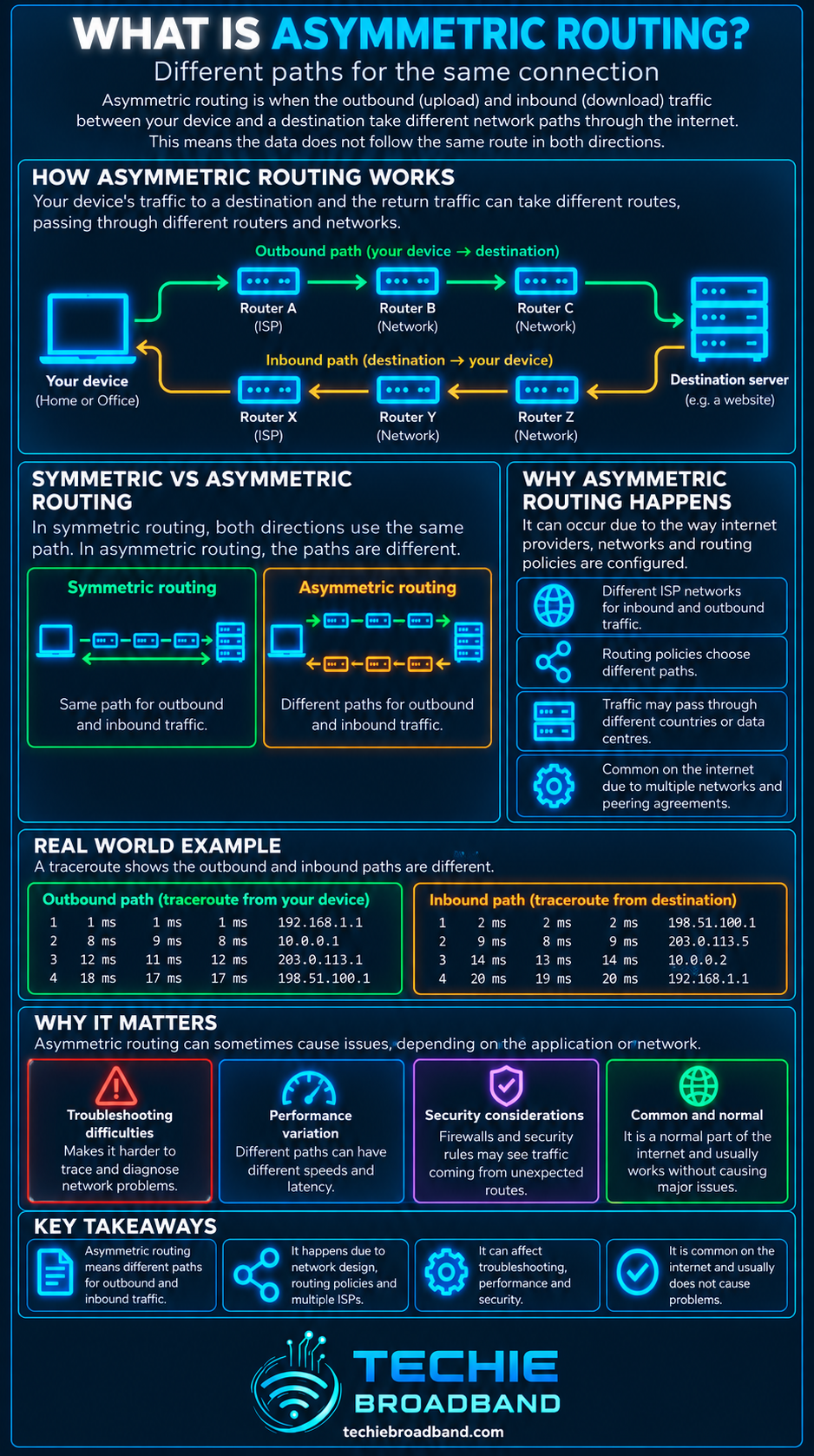
Consider a simplified connection between a UK home and an online service. The outbound path could be Home → ISP edge → ISP core → Peering Partner A → Destination. The return path could be Destination → Transit Provider B → ISP core → ISP edge → Home.
The endpoints are identical, but the middle of the path is different. This is a practical example rather than a claim about one specific ISP. Real internet paths can contain more routers, hidden infrastructure, load balancing and different autonomous systems.
The infographic below shows the important idea: one conversation can legitimately use two different routes.
Why does asymmetric routing happen?
Internet routing is distributed. No single organisation chooses the complete end to end path in both directions. Each network makes forwarding and interconnection decisions using the routing information and policy available to it.
BGP policy: networks can prefer routes according to commercial policy, local preference, AS path information and other routing attributes.
Peering: one network may exchange traffic directly with another at one interconnection while the reverse direction is handed over elsewhere.
Transit: a network can use an upstream transit provider for one direction even when another path is available in the opposite direction.
Hot potato routing: a network may hand traffic to a neighbouring network at an early suitable interconnection rather than carry it farther across its own backbone.
Multihoming: a network connected to multiple providers or interconnection points can legitimately send and receive traffic through different links.
Traffic engineering and failures: maintenance, congestion management, link failures and policy changes can alter one direction without producing an identical change in the other.
RFC 3704 explicitly notes that inter ISP routing is not generally symmetric and discusses the implications for multihomed networks and reverse path filtering. RFC 3704: Ingress Filtering for Multihomed Networks remains an important reference for understanding this interaction.
Asymmetric routing is not the same as asymmetric broadband
The terms sound similar but describe completely different things. Asymmetric routing describes different network paths in opposite directions. Asymmetric broadband describes a service where download and upload capacity are different, such as a connection with a higher download rate than upload rate.
A symmetrical broadband service can still experience asymmetric routing across the wider internet. Equally, an asymmetric broadband service can use a symmetric route to a particular destination. One concerns capacity; the other concerns path selection.
Asymmetric routing is not automatically bad
Different paths do not by themselves mean the connection is inefficient or broken. The internet is designed to route around topology, policy and failures. Two healthy paths can have different hop counts, different physical distances and different interconnection points.
A lower hop count is not automatically a better route, and a different return path is not automatically worse. The useful questions are whether end to end performance is stable, whether packets reach the destination reliably and whether the selected paths introduce a measurable problem.
How asymmetric routing affects latency
Latency measures delay, while asymmetric routing describes path selection. If the outbound and return routes differ, Round Trip Time (RTT) combines delay from two potentially different paths.
This means a 20 ms RTT does not prove that the outbound path took 10 ms and the return path took 10 ms. One direction might account for substantially more of the total. Ordinary ping cannot separate those two components by itself.
This distinction is particularly important when diagnosing latency. A change in RTT may be caused by the outbound route, the return route, both routes or conditions at the destination.
Why traceroute does not show the complete round trip path
Traceroute sends probes with progressively increasing TTL or Hop Limit values and records responses from routers reached along the probe path. That provides useful visibility into the forward direction from the system running the test.
The ICMP replies generated by intermediate routers are themselves packets that need to be routed back to the source. Those replies can take a different path. The destination's return traffic can also follow a different route from the one exposed by the forward traceroute.
That is why traceroute should not be read as a perfect diagram of both directions. It is evidence about a path, not a complete end to end map of every packet in the conversation.
Can asymmetric routing make traceroute timings misleading?
Yes, if the timings are interpreted too literally. A router shown at one hop can respond slowly to diagnostic traffic while continuing to forward ordinary packets normally. Its response can also travel back by a different route from the probe.
An apparently high time at an intermediate hop is therefore not enough to prove that the router is adding the same delay to normal application traffic. Persistent end to end delay or loss at the destination is stronger evidence than one unusual intermediate response.
Asymmetric routing and packet loss
Asymmetric routing can complicate packet loss diagnosis because a failure or filter may affect only one direction. A request might reach a service successfully while the reply is dropped on a different path, or diagnostic responses may be filtered while normal traffic continues.
The correct diagnostic question is therefore not simply 'which hop shows loss?' but 'does the loss persist to the final destination, can it be reproduced, and does it affect the actual application flow?'
Asymmetric routing and reverse path filtering
Reverse path filtering checks whether a packet's source address is plausible according to routing information. Strict unicast Reverse Path Forwarding can require the best route back to the source to use the same interface on which the packet arrived.
That assumption can conflict with legitimate asymmetric traffic. RFC 3704 explains that strict RPF has limitations where routing is asymmetric, while RFC 8704 describes enhanced feasible path uRPF techniques intended to improve source validation in multihomed and asymmetric environments.
This does not mean networks should simply disable source validation. It means the filtering method needs to match the routing design. A policy that assumes perfect symmetry can discard legitimate traffic when valid alternative paths exist.
Asymmetric routing and multihoming
Multihoming means a network has connectivity through more than one external path, often more than one provider. It improves resilience and gives network operators more routing choices, but those choices make asymmetric routing more likely.
A multihomed network may prefer Provider A for outbound traffic while remote networks prefer Provider B when sending traffic back. BGP advertisements, local preference, upstream policy and traffic engineering can all influence the result.
Asymmetric routing, peering and transit
The path between a broadband ISP and a destination can involve both peering and IP transit. One direction may use direct peering while the reverse direction follows a different interconnection or upstream path.
This is one reason why two users reaching the same service through different ISPs can see different performance, and why the same ISP can have different routes to different destinations. The access line is only one part of the complete path.
What asymmetric routing means on UK broadband
For a UK FTTP user, traffic can pass through the home router, access network, ISP aggregation and core network, then through peering or transit before reaching the destination network. The return traffic does not have to retrace those same interconnections.
The exact path depends on the ISP, access network, destination, routing policy, interconnection arrangements and current network state. It is therefore unsafe to infer a universal routing pattern from one traceroute or from the broadband technology alone.
FTTP, XGS PON, Openreach, CityFibre or another access network describes how the customer reaches the provider network. It does not determine the complete internet route to every destination.
Techie Broadband path analysis: why RTT cannot reveal directional delay
Consider a measured RTT of 24 ms. There are many possible directional combinations that produce the same total: 12 ms out and 12 ms back, 8 ms out and 16 ms back, or 18 ms out and 6 ms back. All three produce 24 ms RTT.
Techie Broadband calculation: RTT = outbound delay + return delay. With asymmetric routing, a single RTT measurement cannot tell you which directional combination occurred. The calculation is simple, but the diagnostic implication is important: equal division of RTT between the two directions is an assumption, not a measurement.
How to diagnose a suspected asymmetric routing problem
Establish the actual symptom first. Record whether the problem is latency, packet loss, failed connections, intermittent reachability or application performance.
Test the final destination with ping or an application level check so you have end to end evidence rather than only intermediate hop responses.
Run traceroute from the affected connection and save the complete result with the time and destination.
Repeat the test several times. A single route snapshot can be distorted by load balancing, ICMP rate limiting or a temporary routing change.
Compare results at different times and, where possible, from another network. This helps distinguish a destination specific route from a local access problem.
Test IPv4 and IPv6 separately if both are available because they use separate routing tables and can follow different paths.
Remove VPNs or tunnels temporarily where appropriate because they can deliberately change both the visible source and the route.
Look for persistent end to end changes, not just one slow or silent intermediate hop.
If you operate both endpoints or have remote monitoring, measure from both directions. Two independent traces provide much better evidence of path asymmetry.
Escalate with timestamps, destination addresses, traceroutes and end to end measurements if the evidence points to a repeatable routing or interconnection problem.
Common asymmetric routing misconceptions
Asymmetric routing means something is broken. False. It is common and can be completely healthy.
The return path is simply the outbound path in reverse. Not necessarily. Each direction can be routed independently.
Traceroute shows the complete round trip route. It normally shows the forwarding path of its probes, while replies can return differently.
More hops always means more latency. Hop count and latency describe different properties.
A symmetrical FTTP service guarantees symmetric internet routing. Broadband upload and download symmetry is unrelated to route symmetry.
One slow intermediate traceroute hop proves congestion there. Not necessarily. Router control plane responses and return paths can distort per hop timing.
Asymmetric Routing FAQs
Is asymmetric routing normal on the internet?
Yes. Different networks make independent routing decisions, and inter ISP traffic commonly follows different paths in opposite directions. Asymmetry alone is not evidence of a fault.
Does asymmetric routing increase latency?
Not automatically. It can produce a slower return or outbound path, but it can also use two efficient paths. Measure end to end performance rather than assuming asymmetry is harmful.
Can ping detect asymmetric routing?
Ping measures round trip timing and reachability for its probes. It does not normally reveal the individual route or delay of each direction, so ping alone cannot prove the exact asymmetric paths.
Can traceroute detect asymmetric routing?
A traceroute from one endpoint shows one direction of probe forwarding. To demonstrate different forward paths more directly, you normally need measurements from both ends or another source with visibility of the reverse direction.
Does BGP cause asymmetric routing?
BGP can contribute to asymmetric routing because autonomous systems apply independent policies to route advertisements and path selection. BGP is not the only cause, however. Peering, transit, multihoming, traffic engineering and failures can also change path selection.
Is asymmetric routing the same as asymmetric broadband?
No. Asymmetric routing means the forward and return network paths differ. Asymmetric broadband means download and upload capacity differ. They are separate concepts.
Key takeaway
Asymmetric routing means the path to a destination and the path back are different. That is normal on the public internet and often results from independent BGP policy, peering, transit, multihoming and traffic engineering decisions. The practical consequence is diagnostic: round trip measurements combine two directions, traceroute does not expose the complete return path, and one unusual intermediate hop is not enough to prove a fault.
To explore the related technical concepts used in this Asymmetric Routing guide, visit our broadband terminology guide.
