
What is Network Path Stability?
Updated: 3 days ago

Network path stability describes how consistently traffic between the same source and destination follows the same observed route over time. A stable path tends to retain the same sequence of network hops or the same forwarding behaviour across repeated measurements. An unstable or changing path shows more frequent route changes. Stability matters because a path change can alter latency, jitter, packet loss, capacity and troubleshooting results, but a changed path is not automatically a worse path.
The important distinction is that network path stability is about consistency, not speed and not route length. A stable route can be slow. A changing route can remain fast. The useful question is whether the path is changing often enough, or changing in a way, that affects performance, resilience or diagnosis.
There is no single universal percentage that turns an Internet path into 'stable' or 'unstable'. Stability has to be measured across time, from a defined vantage point, towards a defined destination, using a method that accounts for load balancing and incomplete traceroute responses.
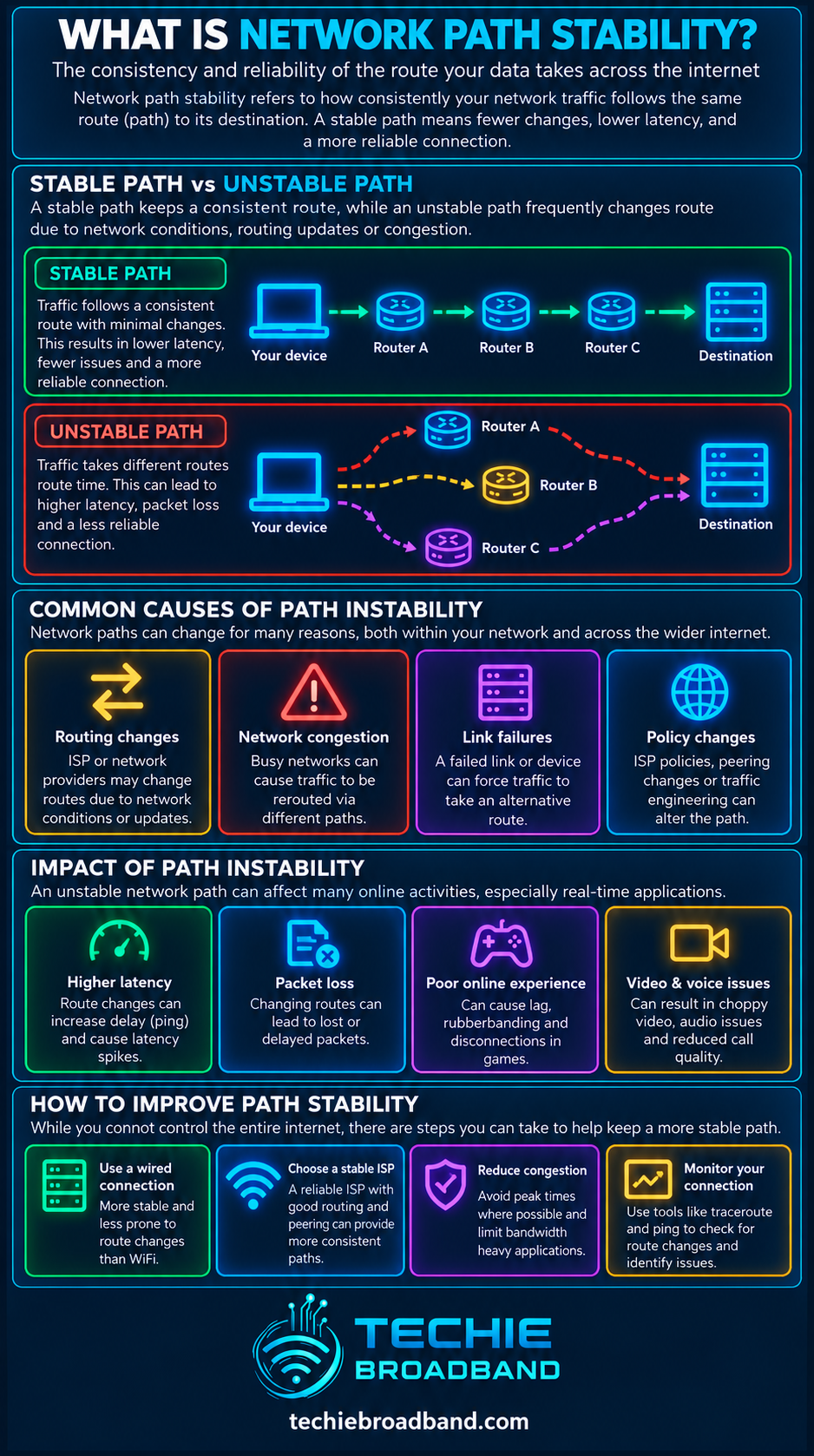
The infographic below summarises the core idea: repeated observations can be considered in terms of how dominant one path is and how long a path persists before changing.
What does network path stability actually measure?
At its simplest, path stability asks whether repeated packets or flows appear to traverse the same route. In practice, that apparently simple question has several layers because the Internet is not one fixed end to end circuit.
Hop sequence stability: whether the same visible router interfaces appear in the same order.
AS path stability: whether traffic continues through the same Autonomous Systems even if individual internal hops differ.
Next hop stability: whether a router continues selecting the same forwarding next hop for a destination.
Performance stability: whether route changes coincide with meaningful changes in latency, jitter, packet loss or throughput.
Temporal persistence: how long an observed path remains in use before another path appears.
The IETF's RFC 9198 route measurement framework defines route metrics and measurement methods for identifying the path taken by a packet or flow. That is useful context because path stability requires repeated route observations, not a single snapshot.
A single traceroute does not measure path stability
A traceroute shows an observed forward path at one point in time. It is valuable for diagnosis, but one trace cannot tell you whether that path has been unchanged for a minute, a day or a month.
To study stability, repeat the measurement under controlled conditions and compare the results. The source, destination, address family, probe method and flow characteristics should remain as consistent as possible. Otherwise, the measurement process itself can create apparent differences.
Run repeated measurements over a period appropriate to the problem.
Keep the same source and destination where possible.
Separate IPv4 and IPv6 observations because they can use different routes.
Record timestamps so route changes can be correlated with performance changes.
Compare hop-level changes with AS-level changes rather than treating every changed interface as a new end to end route.
Measure latency and packet loss alongside route observations.
Load balancing can look like instability when it is not
One of the biggest traps is Equal Cost Multi Path forwarding, usually shortened to ECMP. A router can have multiple valid next hops and distribute different flows across them. Two conventional traceroutes can therefore show different intermediate hops even while the network is operating normally and the set of available paths is stable.
The IETF describes ECMP in RFC 2992 and notes in RFC 7276 that traceroute behaviour can be affected by multiple paths. This is why apparent hop variation should not automatically be labelled route instability.
Per-flow load balancing is especially important. If a network hashes source and destination addresses, ports and protocol information to choose a path, changing probe fields can cause probes to take different valid paths. Tools designed to hold flow-identifying fields stable can provide a clearer picture of temporal change.
What causes a network path to change?
Internet routes change for legitimate operational reasons as well as because of faults. The cause can sit inside an ISP, between networks, inside the destination network or within the local access path.
BGP route selection changes after a new route is learned or an existing route is withdrawn.
A link, router or peering connection fails and traffic is moved to an alternative path.
Traffic engineering deliberately shifts flows to balance utilisation or improve resilience.
An IGP cost or next hop changes inside an Autonomous System.
ECMP or other load balancing selects a different member path.
Maintenance removes a circuit or router from service.
Congestion policy or capacity management changes which interconnection is preferred.
A destination changes its routing announcements or upstream connectivity.
For the inter-domain layer, BGP exchanges reachability information between networks. RFC 4271 explicitly recognises route stability as an operational consideration and says BGP speakers should avoid rapid spontaneous route changes. RFC 4271 is the primary BGP specification.
Network path stability vs route flapping
Network path instability is broader than route flapping. A path can change occasionally because of normal maintenance, traffic engineering or failover without flapping. Route flapping describes repeated routing changes over a relatively short period and can generate repeated control-plane updates.
The IETF's RFC 2439 on BGP Route Flap Damping describes a stability-sensitive mechanism based on recent route history. That is a control-plane concept. An end user observing changing traceroute hops is seeing a data-plane symptom and cannot assume BGP flapping is the cause.
Network path stability vs asymmetric routing
A path can also be stable and asymmetric. Asymmetric routing means the forward and return paths differ. If both directions consistently use their respective routes, the routing can be asymmetric but stable.
Conventional traceroute primarily reveals the forward path from the measurement source towards the destination. It does not, by itself, reveal the reverse route taken by the replies. A changed return path can therefore alter measured round trip latency without appearing as an obvious forward-path change.
How path changes can affect broadband performance
A route change matters to a broadband user only when it changes something relevant to the application or diagnosis. The new route might be equally good, better or worse.
Latency can change because the new route covers a different physical distance or traverses different equipment.
Jitter can change if queueing behaviour differs along the new path.
Packet loss can appear or disappear if the new path includes a congested or faulty segment.
Throughput can change if the new route reaches a different bottleneck or interconnection.
Geolocation can appear different if traffic exits through a different city or network edge.
Traceroute output can change even when application performance remains effectively identical.
These effects are why path analysis should be interpreted alongside latencyjitter and packet loss rather than from hop names alone.
Techie Broadband calculation: dominant path prevalence
A useful descriptive measure is dominant path prevalence: the proportion of repeated observations in which the most commonly observed path appears. This is a Techie Broadband calculation for interpretation, not an Internet standard and not a universal pass or fail threshold.
Suppose you run 288 controlled route measurements at five minute intervals over 24 hours. The same dominant path is observed 250 times, while one or more alternatives appear 38 times.
Total observations = 288
Dominant path observations = 250
Alternative path observations = 38
Dominant path prevalence = 250 ÷ 288 × 100 = 86.8%
Alternative observations = 38 ÷ 288 × 100 = 13.2%
An 86.8% dominant-path prevalence tells you how often the most common observed path appeared in this sample. It does not tell you whether the 13.2% of alternative observations were harmful. If those alternatives produced the same latency and no loss, the practical impact may be negligible. If they coincided with latency doubling or packet loss, the same percentage becomes much more significant.
Techie Broadband calculation: path transition rate
A second useful measure is how often one observation differs from the immediately preceding observation. If 24 hourly measurements create 23 transitions between samples and the path changes three times, the observed transition change rate is:
3 ÷ 23 × 100 = 13.0%
Again, this is a descriptive calculation rather than a standard stability score. Sampling interval matters. A five minute test can reveal changes that an hourly test completely misses, while very frequent testing may capture short-lived routing events that have no user-visible effect.
Prevalence and persistence answer different questions
A path can dominate the sample yet still change frequently. For example, Path A could appear for most measurements but repeatedly alternate with Path B for short periods. Conversely, two paths could each persist for twelve hours, producing a 50/50 prevalence split but only one transition.
Prevalence asks: how often was this path observed?
Persistence asks: how long did it remain before changing?
Transition rate asks: how often did consecutive observations differ?
Performance correlation asks: did the changes coincide with measurable degradation?
Using these together produces a much more useful picture than labelling a route stable because one path appeared most often.
UK broadband context
For a UK broadband connection, the observed Internet path can include the home network, access network, ISP aggregation and core, peering or transit interconnections, another provider's network and the destination infrastructure. A route change can occur in any of those domains.
FTTP, FTTC, cable, fixed wireless and mobile services use different access architectures, but path stability beyond the access network is still governed by routing and forwarding decisions. The retail ISP, underlying access network, product and location all matter. Two customers using the same ISP can reach the same destination through different paths.
Multi gigabit broadband does not guarantee a more stable Internet route. Higher access capacity increases the amount of traffic the local connection can carry, while path stability concerns route consistency. They describe different properties.
Does a stable path mean better broadband?
No. Stability is useful, but it is not a quality score by itself. A consistently congested route can be extremely stable and still perform badly. A resilient network may deliberately change paths during a failure and preserve service, which is exactly the behaviour you want.
Stable and fast: consistent route with good performance.
Stable and slow: consistent route with a persistent bottleneck or long distance.
Changing and fast: multiple valid paths with similar performance.
Changing and degraded: route changes correlate with increased delay, loss or reduced throughput.
How to test network path stability
The objective is to separate real temporal route changes from measurement artefacts and then determine whether any genuine changes affect performance.
Use wired Ethernet where practical so local WiFi variation does not confuse the test.
Choose a fixed destination that is relevant to the problem.
Test IPv4 and IPv6 separately.
Run a baseline traceroute and record the timestamp.
Repeat measurements at a consistent interval over a meaningful period.
Keep probe characteristics consistent so ECMP does not create artificial variation.
Compare both visible hop sequences and Autonomous System paths where possible.
Record latency, jitter and packet loss at the same time.
Mark when the path changes and compare the performance before, during and after the change.
Repeat from another destination or measurement point before blaming the ISP.
How to interpret traceroute changes correctly
Traceroute is an inference tool. Routers can rate-limit or ignore probe traffic, interfaces can reply using addresses that are not intuitive, MPLS can hide parts of a path and load balancing can expose multiple valid next hops. Missing or changed hops therefore need context.
One non-responding hop does not prove packet loss to the destination.
A different intermediate IP address does not automatically mean the end to end route materially changed.
A longer visible hop count does not automatically mean higher latency.
A changed hostname does not prove a physical location changed.
A route change that coincides with a performance change is more diagnostically useful than a route change by itself.
What should you understand before blaming routing?
Start with the wider concept of routing and use traceroute as one diagnostic input. If the problem is intermittent delay, compare the route observations with latency and jitter. If packets fail to arrive, investigate packet loss. If routes repeatedly appear and disappear at the control-plane level, route flapping becomes more relevant.
Also eliminate local causes. A saturated upload, bufferbloat, WiFi interference, router CPU limitations or a faulty Ethernet link can create poor performance while the external Internet path remains unchanged.
Common misconceptions about network path stability
The shortest traceroute is always best. False: hop count does not directly measure physical distance, queueing or capacity.
Any changed hop means instability. False: ECMP and router response behaviour can expose different hops during normal operation.
A stable route guarantees low latency. False: a route can be consistently slow.
A route change means the ISP has a fault. False: maintenance, resilience and traffic engineering can all cause legitimate changes.
One traceroute proves the route. False: it is one observation from one source towards one destination.
IPv4 and IPv6 should follow the same path. False: they can have different routing policies and interconnections.
Network path stability FAQs
What is a stable network path?
A stable network path is one that remains reasonably consistent across repeated observations from the same source to the same destination under comparable measurement conditions. Stability does not require every visible traceroute response to be identical.
How do I know if my Internet route is changing?
Run repeated controlled route measurements and compare them over time. Look for recurring changes in hop sequence or AS path, then correlate those changes with latency, jitter, packet loss and application behaviour.
Can BGP cause network path instability?
Yes. BGP route withdrawals, new advertisements, policy changes and convergence can change inter-domain paths. However, a changed traceroute does not by itself prove that BGP was the cause.
Can load balancing make a path look unstable?
Yes. ECMP and other load-balancing techniques can distribute different flows across multiple valid paths. Probe design matters when distinguishing normal multipath forwarding from temporal instability.
Is path stability the same as latency stability?
No. Path stability describes route consistency. Latency stability describes consistency of delay. A route can remain unchanged while queueing makes latency vary, or the route can change while latency stays almost identical.
Does route flapping always cause packet loss?
No. Routing changes can cause transient disruption, but the outcome depends on topology, convergence, forwarding behaviour and application tolerance. Some changes are effectively invisible to the user.
Should I worry if traceroute changes occasionally?
Not necessarily. Occasional changes are normal on a resilient Internet. Investigate when changes are frequent, persistent or strongly correlated with measurable performance problems.
Key takeaway
Network path stability is the consistency of the observed route between a source and destination over time. It is best understood through repeated measurements, not a single traceroute, and it must be interpreted carefully in networks that use ECMP or other load balancing.
The most useful analysis combines path prevalence, persistence and transition behaviour with latency, jitter, packet loss and application performance. A path change is evidence that routing or forwarding behaviour differed. It is not, by itself, evidence that the network became worse.
To explore the related technical concepts used in this Network Path Stability guide, visit our broadband terminology guide.
